
How to measure a skirt: waist, hips and length
Measure your waist where the skirt's waistband will sit, your hips around the fullest part with your feet together, and the length from that waist line down to where you want the hem. On a skirt laid flat, measure across the waistband and the hips, double both, and measure the length from the top of the waistband to the hem.
A skirt is sized by two circumferences and one length. The waist has to close, the hips have to fit inside, and the length decides where the hem falls on your leg. Shoppers measure their body; merchants measure the skirt laid flat. Both are below.
How to measure yourself for a skirt
- Find where the skirt will sit. A high-waisted skirt sits at the natural waist, the narrowest part of the torso. Others sit lower, closer to the hip bones. Put on a skirt you like and note where its waistband rests.
- Waist. Around that line, tape level, snug but not pressing in, after a normal breath out. Don't pull your stomach in.
- Hips. Feet together, around the fullest part of your hips and seat, tape level. Slide it up and down a little and keep the largest reading.
- Length. From the waist line of step 1, straight down the front of the leg to where you want the hem: above the knee, at the knee, mid-calf or ankle. A mirror or a second person helps.
- Write down the units with each number.
The waist guide and the hips guide cover those two measurements in more detail, mistakes included.
How to measure a skirt laid flat
- Close it and lay it flat: zip and buttons done up, front facing up. Smooth it without pulling. Fold pleats closed, the way they hang.
- Waist. Straight across the top of the waistband, edge to edge. That's half the waist. On an elastic waistband, measure it relaxed; give the stretched width too if you like.
- Hips. Straight across at hip level, below the waist. Pick a distance from the top of the waistband and keep it for every size. Also a half.
- Length. From the top of the waistband straight down to the hem, at the center front or the center back. Say which: on a curved or high-low hem, give both.
- Hem width, for straight and pencil skirts: straight across the bottom edge. It says how freely the wearer can walk.
- Slit, if there is one: from the hem to the top of the slit.
Double the waist, hip and hem widths for the measurements around. Lengths are never doubled.
Skirt lengths have names, not numbers
Mini, knee length, midi and maxi are where a hem falls, and that depends on the wearer's height as much as on the skirt. A midi on one shopper is a maxi on a shorter one. So give the length of each size in centimeters and inches, and let shoppers compare it with their own waist-to-hem measurement from step 4.
Common mistakes
- Using the natural waist for a skirt that sits lower, or the reverse.
- Measuring the hips at the hip bones. The fullest part is usually lower.
- Stretching an elastic waistband while measuring it flat.
- Length from the bottom of the waistband, or along the side on one size and the front on the next.
- Pleats spread open on the table.
- Halves without saying so. Under a plain "Waist (cm)" header, 38 reads like a body nobody has.
What it means for a Shopify store
Which measurement decides depends on the cut. On a pencil or straight skirt, the hips are often the limit, so shoppers should go by the larger of their two sizes. On an A-line or a full skirt, the hips have room to spare and the waist decides. Say which in a fit note.
Then give shoppers what they need to compare:
- Where the waistband sits: high, mid or low.
- The length of each size, not one length for the range, if it changes between sizes.
- Stretch or not. A stretch waistband changes what "fits" means.
- Body or garment in the header: "Waist (cm)" for the body, "Waist, laid flat (cm)" for the skirt.
How Ruban Size handles skirts
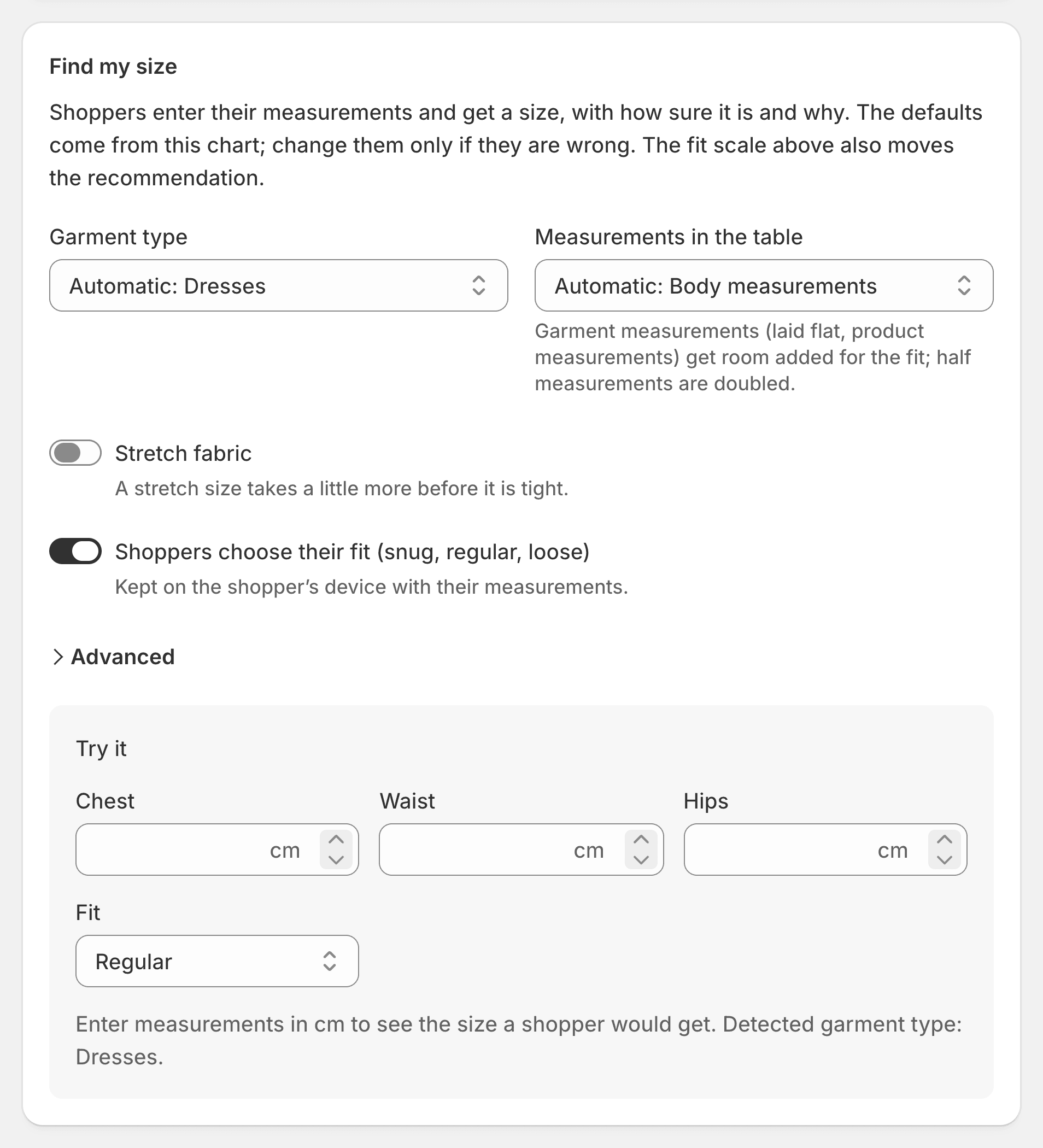
There is no skirt template among the 39, so start from your own table (pasted from a spreadsheet into the editor) or from a template with the rows you need, such as Dresses without its bust row. A chart whose title or tab says skirt (or jupe, Rock, falda, gonna) is read as "Pants, shorts and skirts" by Find my size, with the waist counting most and the hips close behind.
Body charts. On a skirt chart with the waist and hip ranges of the Dresses template, a 70 cm waist (an S) with 101 cm hips (an M) reads "You are between S and M. We suggest M.": the skirt has to go over the hips.
Garment charts. When the table holds the skirt's own measurements, Find my size doubles the halves and adds the ease of skirts and pants, in centimeters around the body: 2.5, 3.2 or 3.8 at the waist and 6.4, 9 or 12.9 at the hips, for Snug, Regular and Loose. The hip values are the midpoints of the Vogue, Butterick and McCall's allowances for skirts and pants (2 to 3, 3⅛ to 4 and 4⅛ to 6 in); the waist values follow the 1 to 1.5 in minimum of Threads #221 (2023).
Take an example chart with "Waist, laid flat (cm)" at 33, 35.5, 38, 41 and 44, and "Hips, laid flat (cm)" at 48, 50.5, 53, 56 and 59, for XS to XL. Doubled, the M is 76 cm at the waist and 106 cm at the hips. A shopper with a 72 cm waist and 98 cm hips, Regular fit: 72 + 3.2 = 75.2 and 98 + 9 = 107, both in M. "Your size: M", with "Waist 72 cm: M, middle of the range" and "Hips 98 cm: M, middle of the range". With "Fit I like: Loose", the hips need 110.9 cm: "You are between M and L. We suggest L."
Settings. In the chart's Fit tab, "Measurements in the table" says body or garment when the headers don't, and "Stretch fabric" takes a little room off for an elastic or stretch skirt: the same shopper then gets S. "Main measurement" makes the hips count most, for pencil skirts. The length row isn't a measurement Find my size uses; as "Other values", it shows and converts between cm and in. The full grid is on the size charts page.
Questions
How do you measure skirt length?
On your body, from where the waistband will sit straight down to where you want the hem. On a skirt laid flat, from the top of the waistband straight down to the hem, at the center front.
Should a skirt fit at the waist or the hips?
Both. On straight and pencil skirts the hips are often the limit, so go by the larger of your two sizes; on A-line and full skirts, the waist decides.
Where should I measure my waist for a skirt?
Where the skirt's waistband will sit. That's your natural waist for a high-waisted skirt, and lower, nearer the hip bones, for a mid or low rise.
What size skirt if my waist and hips are different sizes?
Take the size that fits the larger measurement, and have the waist taken in if it gapes. For an elastic or stretch waistband, the hips decide.
Keep reading
- How to measureHow to measure your waist (and why pants differ)Measure your natural waist around the narrowest part of your torso, tape level, after a normal breath out. For pants and jeans, also measure where the waistband actually sits, because a pant size like 32 is a label, not always your natural waist.5 min
- How to measureHow to measure your hipsStand with your feet together and wrap the tape around the fullest part of your hips and seat, level all the way round. That is the hip measurement dresses, swimwear, leggings and jeans are sized by, and often the one that decides.5 min
- How to measureHow to measure a dress for your size chartLay the dress flat and closed, then measure straight across the bust (armpit to armpit), the waist and the hips, and from the top of the shoulder down to the hem. The widths are halves: double them for the measurements around, and say in the chart which ones you publish.6 min
- How to measureHow to measure your chest for clothesPass the tape under your arms and around the fullest part of your chest, keep it level all the way round, and read it after a normal breath out. That number is your chest; on a women's chart labeled bust, the tape takes the same path.6 min