
Japanese, Chinese and Korean clothing sizes explained
A Chinese label like 170/88A means 170 cm tall, a chest of 88 cm and body type A. A Japanese women's size like 9AR codes the bust, the hip type and the height. Korean tags give the chest or the height in centimeters. Read those numbers, not the letter.
Many Asian size labels print the body the garment is made for, in centimeters. Once you know where each number sits, that is easier to use than a letter: compare it with your own height and chest and you know where you stand.
This article doesn't give an Asian-to-US conversion table. The labels below follow national standards, but each brand cuts its own garments to them, and a letter on a Japanese or Chinese tag means what that brand's chart says it means. Measure yourself, decode the label, then check the brand's measurements.
The label systems at a glance
| Country | Standard | Label example | What it says |
|---|---|---|---|
| China, tops | GB/T 1335 | 170/88A | Height 170 cm, chest (or bust) 88 cm, body type A |
| China, bottoms | GB/T 1335 | 170/74A | Height 170 cm, waist 74 cm, body type A |
| Japan, women | JIS L 4005 | 9AR | Bust code 9, hip type A, height class R |
| Japan, men | JIS L 4004 | Letter and number | Body type letter and a height number |
| Korea | National labels | 95 | Chest (or bust) in cm, often with the height |
The numbers in the examples are label formats, not sizes to buy. In inches, 170 cm is 66.9 in (5 ft 7 in), 88 cm is 34.6 in and 74 cm is 29.1 in.
China: GB/T 1335
A Chinese label reads height / girth, then a letter. The first number is the height of the person the garment is for, in centimeters. The second is a body measurement in centimeters: the chest on a man's top, the bust on a woman's top, the waist on pants and skirts. The letter is the body type, set by the difference between chest and waist:
- Y: the largest difference, a slim build.
- A: the usual build.
- B: a smaller difference, fuller at the waist.
- C: the smallest difference, fullest at the waist.
So 170/88A is a top for someone about 170 cm tall with an 88 cm chest and an average build, and 170/74A the matching pants, for a 74 cm waist. Tags often add a letter size beside it, "M 170/88A". The numbers are the part to read; the letter is the brand's.
To use it, compare the numbers with your measurements, then with the brand's chart. A woman with an 88 cm bust is an S in Ruban Size's Dresses template (85 to 89 cm); a man with an 88 cm chest is an S in its Men's T-shirts template (88 to 95 cm). Neither is a rule for the brand you're buying from; both show that the label's number, not its letter, is what travels.
Japan: JIS L 4005 for women
Japanese women's sizes are a code of three parts, as in 9AR:
- A number for the bust, odd numbers rising with the bust: 5, 7, 9, 11, 13 and so on.
- A letter for the hips at that bust: A for the standard hips, Y for slimmer hips, AB and B for fuller ones.
- A letter for the height: P for shorter, R for regular, T for taller.
A 9AR is therefore a bust code 9, standard hips, regular height. Tags often shorten it to the number alone; the full code adds the hips and the height. The code stands for body measurements set in the standard; the brand's chart gives the centimeters for its own garments, and that is the number to compare with yours.
Men's clothes follow a separate standard, JIS L 4004, with body type letters for the difference between chest and waist and a number for the height. Here too, the brand's chart in centimeters is the reliable part.
Korea: centimeters on the tag
Korean tags often give the size as the chest or bust in centimeters, such as 90, 95 or 100 for tops, and the height in centimeters beside it. A 95 top is made for a chest of about 95 cm (37.4 in). As everywhere, the garment itself is larger than that body measurement, by the ease the brand chose: see body measurements vs garment measurements.
Across all three countries, children's clothes are often labeled by height alone, 110 or 120 for example. That matches the rule of Ruban Size's kids' templates: "Choose by height first: age is only a guide."
Shoes and rings
Japanese shoe sizes are the foot length in centimeters. Ruban Size's engine rounds it to the nearest half size, so a 24.5 cm foot is a JP 24.5. Korean shoe sizes give the same length in millimeters, 245. The Japanese scale is in the shoe size conversion chart, next to EU, UK and US; for a Korean size, divide by 10 and read the JP column.
Japanese ring sizes are whole numbers of their own: in the engine, a US 5 is a JP 9 and a US 7 a JP 14.
Why letters don't convert
A letter is one brand's grouping of measurements. Even within one app, letters move: Ruban Size's Men's T-shirts template puts S at an 88 to 95 cm chest, its Men's shirts template at 88 to 94. Between countries and brands the gaps are larger, which is why a medium isn't the same size at every brand. A table that says "Asian L = US M" can only be one brand's chart.
How to read an Asian size label
- Measure yourself: height, chest or bust, waist, hips.
- Find the centimeters on the tag and read them as above: height first on a Chinese label, chest or bust on a Korean one.
- Check the body type letter on a Chinese or Japanese label against your build.
- Open the brand's chart for the garment measurements, and choose from those.
How a Shopify store should show Asian sizes
- The label printed on the tag as a row of its own (CN, JP or KR), so shoppers can match what they will receive.
- The measurements behind each size, in centimeters with a switch to inches.
- A line on how the brand's sizes run against the sizes your shoppers know, written from your own samples.
- The guide in your shoppers' language if you sell into Japan, China or Korea.
How Ruban Size does it
In the size chart editor, a row headed CN, JP or KR is read as size labels, never as measurements, so 170/88A stays exactly as typed. Mark it as a size system and shoppers switch to it above the table, as they do between US, UK and EU. The sizes themselves can be the labels: a chart with sizes 165/84A, 170/88A and 175/92A and a chest row works with Find my size like any other, and answers "Your size: 170/88A".
Find my size only compares measurements, so it doesn't care which label system the chart uses. Shoppers enter their chest in centimeters or inches, the size comes from the numbers, and the label is shown as written.
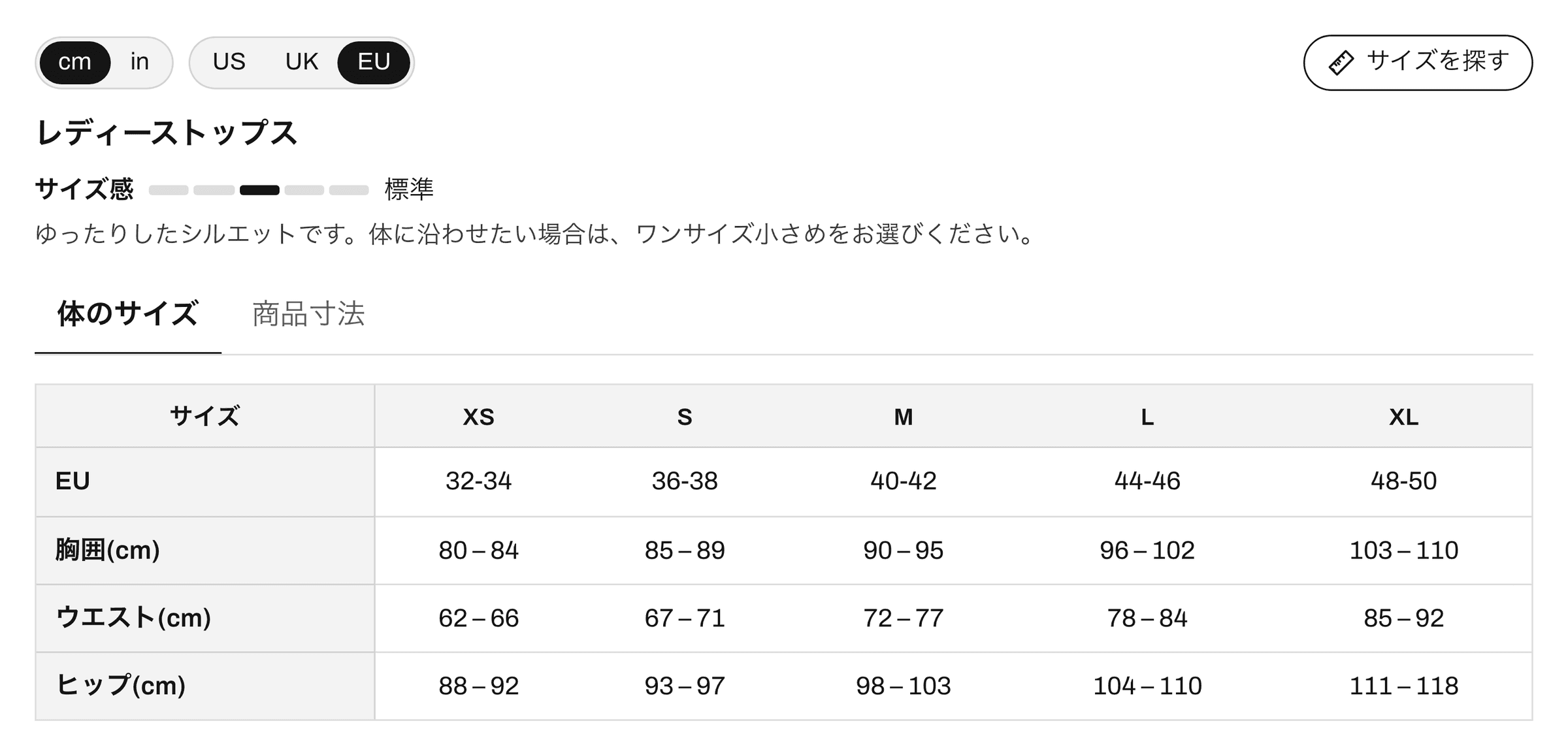
The guide speaks 22 languages, Japanese, Chinese (simplified and traditional) and Korean among them, and the templates come translated in the store's languages. With translations, each chart is translated field by field; sizes and numbers are never translated. Here is the guide in Japanese:
Questions
What does 170/88A mean on clothing?
It is a Chinese GB/T 1335 label: made for a height of 170 cm (5 ft 7 in) and a chest or bust of 88 cm (34.6 in), with body type A, the usual build. On pants, the second number is the waist.
What is a size 9 in Japanese women's clothing?
A bust code in the JIS L 4005 system, usually 9AR in full: bust code 9, standard hips (A), regular height (R). Check the brand's bust measurement in centimeters rather than converting the number.
Do Asian sizes run small?
The letters can't be compared across brands, Asian or not. The centimeters on Chinese and Korean labels are body measurements, so compare those with yours, then read the brand's chart.
Are Japanese shoe sizes in centimeters?
Yes. A Japanese shoe size is the foot length in centimeters, rounded to the half size in Ruban Size's engine: a 26 cm foot is a JP 26.
Keep reading
- Sizing explainedWhy a medium isn't the same size at every brandA medium is a name, not a measurement. Each brand decides which body its M fits, how much room it leaves and how sizes step up, so the fix is to publish the measurements behind your M and a one-line fit note.5 min
- Sizing explainedBody measurements vs garment measurementsA body measurement is the person; a garment measurement is the product, often laid flat and halved. The gap between the two is ease, and comparing one with the other is the quickest way to a wrong size.6 min
- Size conversionShoe size conversion chart from foot lengthA 26.5 cm foot (10.4 in) is about EU 42, UK 8.5, US men's 9.5, US women's 10.5 and JP 26.5. The chart below runs from 22 to 30 cm; a brand's own chart always wins.6 min
- Size conversionRing size conversion chart: US, UK, EU and JapanA US 7 ring measures about 54.4 mm around the inside and 17.3 mm across. That is UK N 1/2, EU 54.5 and Japan 14. The full chart, from US 3 to 13, is below.6 min