
Ring size conversion chart: US, UK, EU and Japan
A US 7 ring measures about 54.4 mm around the inside and 17.3 mm across. That is UK N 1/2, EU 54.5 and Japan 14. The full chart, from US 3 to 13, is below.
Take the inner circumference of a ring that fits, or of your finger, in millimeters, and read across the row. All four systems describe the same thing, the inside of the ring, but each counts it its own way, so the numbers never line up neatly.
Every value below is computed by the conversion code inside Ruban Size, from the standards it cites. It is a close guide, not a promise: a jeweler's own chart wins over any conversion table.
Ring size conversion chart
| US | Inner circumference (mm) | Inner circumference (in) | Inner diameter (mm) | UK | EU | JP |
|---|---|---|---|---|---|---|
| 3 | 44.2 | 1.74 | 14.1 | F 1/2 | 44 | 4 |
| 3.5 | 45.4 | 1.79 | 14.5 | G 1/2 | 45.5 | 6 |
| 4 | 46.7 | 1.84 | 14.9 | H 1/2 | 46.5 | 7 |
| 4.5 | 48.0 | 1.89 | 15.3 | I 1/2 | 48 | 8 |
| 5 | 49.3 | 1.94 | 15.7 | J 1/2 | 49.5 | 9 |
| 5.5 | 50.5 | 1.99 | 16.1 | K 1/2 | 50.5 | 10 |
| 6 | 51.8 | 2.04 | 16.5 | L 1/2 | 52 | 11 |
| 6.5 | 53.1 | 2.09 | 16.9 | M 1/2 | 53 | 12 |
| 7 | 54.4 | 2.14 | 17.3 | N 1/2 | 54.5 | 14 |
| 7.5 | 55.6 | 2.19 | 17.7 | O 1/2 | 55.5 | 15 |
| 8 | 56.9 | 2.24 | 18.1 | P 1/2 | 57 | 16 |
| 8.5 | 58.2 | 2.29 | 18.5 | Q 1/2 | 58 | 17 |
| 9 | 59.5 | 2.34 | 18.9 | R 1/2 | 59.5 | 18 |
| 9.5 | 60.7 | 2.39 | 19.3 | S 1/2 | 60.5 | 19 |
| 10 | 62.0 | 2.44 | 19.7 | T 1/2 | 62 | 20 |
| 10.5 | 63.3 | 2.49 | 20.1 | U 1/2 | 63.5 | 21 |
| 11 | 64.6 | 2.54 | 20.5 | V 1/2 | 64.5 | 23 |
| 11.5 | 65.8 | 2.59 | 21.0 | W 1/2 | 66 | 24 |
| 12 | 67.1 | 2.64 | 21.4 | X 1/2 | 67 | 25 |
| 12.5 | 68.4 | 2.69 | 21.8 | Y 1/2 | 68.5 | 26 |
| 13 | 69.7 | 2.74 | 22.2 | Z 1/2 | 69.5 | 27 |
The inches column is the millimeters divided by 25.4. The diameter is the circumference divided by pi (3.1416).
How to read the chart
- Measure the inner circumference: wrap a strip of paper around the base of the finger, mark where it overlaps, and measure the strip flat. Or measure across the inside of a ring that already fits, edge to edge: that is the inner diameter.
- Find the closest value in the matching column.
- Read the size in the system you need, on the same row.
The steps are small. One US size is 2.55 mm around, or 0.81 mm (0.032 in) across. One UK letter is 1.25 mm, which is why each US half size lands on the next UK letter. A 1 mm slip with the paper strip is already about 0.4 of a US size, so measure twice. If you have no tape at all, how to measure your ring size at home walks through both methods.
The Rings template adds one note worth repeating: fingers swell in the heat, so measure at the end of the day.
Where each system comes from
EU: ISO 8653
The international standard ISO 8653 sizes a ring by its inner circumference in millimeters. An EU 54 ring measures 54 mm around the inside. The chart rounds to the nearest half millimeter, as the engine does.
US and Canada
US sizes follow a straight line: circumference C = 2.55 s + 36.5 mm, where s is the size. Each whole size adds 2.55 mm around. Quarter sizes are common in the US, so the engine rounds US sizes to the nearest quarter.
UK, Ireland and Australia
Letters, one per 1.25 mm, with C at 40 mm, as set by the British Standards Institution in 1987. Half letters sit in between (N 1/2). Past Z, sizes carry on as Z+1, Z+2 and so on.
Japan
Japanese sizes are whole numbers that do not follow the circumference in a straight line. Ruban Size fits them on the usual table: US 5 is JP 9, US 7 is 14, US 9 is 18 and US 12 is 25. JP 13 and 22 are missing above only because the chart steps by US half sizes.
The engine's notes give its reference for all four: ISO 8653:2016 as summarized on Wikipedia's "Ring size" page, read in November 2026. It converts circumferences from 38 to 76 mm.
To convert a single measurement, the converter below runs the same code. There is also a ring size converter page of its own.
Ring size converter full page and table
Wrap a strip of paper around the base of the finger, mark where it overlaps, measure the strip.
- US and Canada
- 7
- UK and Australia
- N 1/2
- EU (ISO 8653)
- 54.5
- Japan
- 14
- Diameter
- 17.3 mm
- Circumference
- 54.4 mm
Why ring conversions are approximate
Each system rounds, and each maker rounds a little differently. Some charts list US 5 as EU 49 and US 12 as Y, where the formulas above give 49.5 and X 1/2, the sizes Ruban Size's Rings template shows. Half a size either way is the normal wiggle between two ring charts, and the reason to trust the brand's chart over this one.
Band width matters too. A wide band, 6 mm and more, sits tighter on the finger than a thin one of the same size. Between two sizes, take the larger one for a wide band.
How a Shopify store should show ring sizes
- One column per system, US, UK, EU and JP if you sell in Japan, each marked as a size system. Shoppers switch between them and see one at a time, the one they know.
- The first system shown follows the shopper's country: US in the United States, UK in the United Kingdom and Ireland, EU elsewhere. Remember the shopper's choice from one product to the next.
- The measurements beside the sizes, inner circumference and inner diameter, with a switch between centimeters and inches.
- A way to measure without a tape: the paper strip, or a ring the shopper already owns.
- A line on wide bands if you sell them.
How Ruban Size does it
The Rings template comes with US 5 to 12 in US, UK and EU columns, each marked as a size system, the inner diameter and inner circumference in centimeters, and the paper strip steps. Like every template, it opens as a draft and shows nowhere until you save it and choose its products. On the product page, shoppers switch systems above the table, the first one follows their country, and the cm/in switch converts the measurement columns (inches first for shoppers in the US).
Find my size for rings asks for the finger's circumference, or "the inner diameter of a ring that fits you", under a short help titled "No tape measure? Two easy ways". The answer gives the size in the chart's own system, then adds the systems the chart does not show, under "Usual equivalents (approximate)". On the Rings template, which already has US, UK and EU, that line adds the Japanese size.
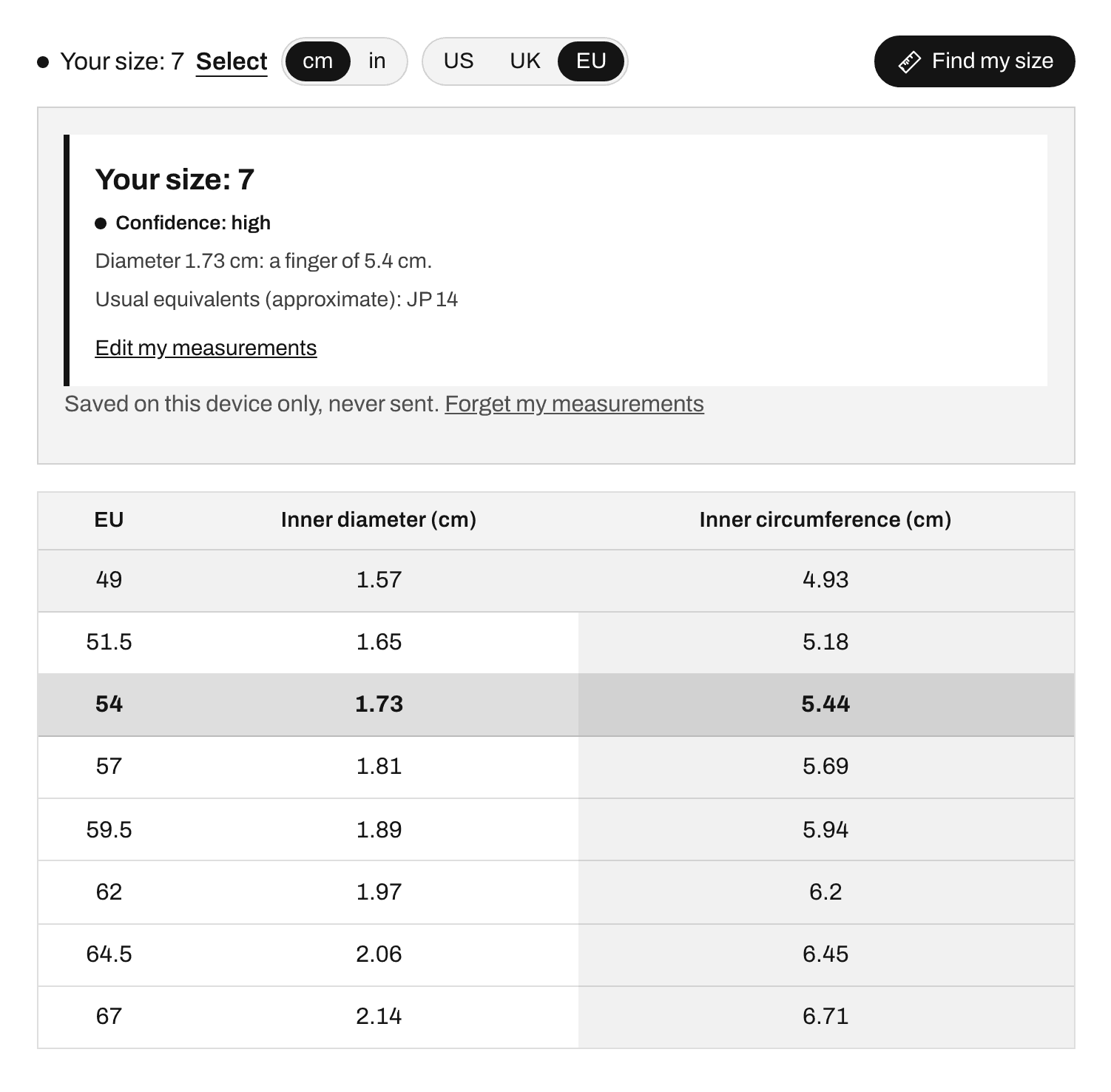
Rings get no Snug, Regular or Loose choice: a ring fits or it doesn't. In the chart's Fit tab, "Wide band (6 mm and more)" tells shoppers to take the larger size between two. The general settings of Find my size (confidence, saved measurements, "Select this size") work the same as on clothing.
Questions
What is a US size 7 ring in UK and EU sizes?
About UK N 1/2 and EU 54.5, for an inner circumference of 54.4 mm and a diameter of 17.3 mm. In Japan it is a 14.
How do I convert ring diameter to circumference?
Multiply the diameter by pi, 3.1416. A 17.3 mm ring is about 54.4 mm around, a US 7.
Are EU and UK ring sizes the same?
No. EU sizes are the inner circumference in millimeters (ISO 8653), while UK sizes are letters, one per 1.25 mm, with C at 40 mm. EU 54.5 is about UK N 1/2.
What US size is a Japanese ring size 9?
US 5, about 49.3 mm around the inside, on the table Ruban Size uses (US 5 is JP 9, US 7 is 14, US 9 is 18, US 12 is 25).
Keep reading
- How to measureHow to measure your ring size at homeWrap a strip of paper around the base of your finger, mark where it overlaps and measure the length in millimeters: that is your inner circumference, and your EU ring size. No paper? Measure across the inside of a ring that fits the same finger: that is the inner diameter.5 min
- Size conversionCentimeters to inches for size charts, fractions includedAn inch is exactly 2.54 cm, so divide centimeters by 2.54. Round body measurements to the quarter inch, small ones like hands and feet to the eighth, and heights to the whole inch in feet and inches.5 min
- Find my sizeHow Find my size works, step by stepFind my size reads your chart as ranges with no gaps, works out a target for each measurement, scores every size, and shows the best one with how sure it is and why. It runs on the shopper's device and never suggests a size beyond your largest.7 min
- Size conversionShoe size conversion chart from foot lengthA 26.5 cm foot (10.4 in) is about EU 42, UK 8.5, US men's 9.5, US women's 10.5 and JP 26.5. The chart below runs from 22 to 30 cm; a brand's own chart always wins.6 min