
How to measure your ring size at home
Wrap a strip of paper around the base of your finger, mark where it overlaps and measure the length in millimeters: that is your inner circumference, and your EU ring size. No paper? Measure across the inside of a ring that fits the same finger: that is the inner diameter.
There are two ways to find a ring size at home, and both end in millimeters. Around the finger, you get the inner circumference: in the EU system (ISO 8653) that number is the size. Across the inside of a ring you already wear, you get the inner diameter, which gives the same circumference once multiplied by 3.1416.
Method 1: the paper strip
- Cut a strip of paper, narrow, and long enough to go around your finger with some overlap. Paper is better than string, which stretches and twists.
- Wrap it around the base of the finger that will wear the ring, flat and snug, not tight.
- Mark where it overlaps, with a fine pen.
- Unroll it and measure from the end to the mark, in millimeters.
- Check the knuckle. Slide the loop of paper off over the knuckle. If it won't pass, measure around the knuckle too: the ring has to go over it.
- Measure twice, on the hand you'll wear the ring on. The fingers of your two hands can differ.
These are the steps of the Rings template in Ruban Size: "Wrap a strip of paper around the base of your finger. Mark where it overlaps and measure the length: that is the inner circumference." The template adds a note: "Fingers swell in the heat: measure at the end of the day."
Method 2: a ring that already fits
- Pick a ring that fits the same finger, a thin band if you have one.
- Lay it on a ruler and measure across the inside, edge to edge, at the widest point, in millimeters. Not the outside, and not the metal.
- That is the inner diameter. Multiply by 3.1416 for the circumference, or read it in the table below.
Common mistakes
- String or thread, which stretches.
- Measuring the outside of a ring.
- Cold fingers. Fingers swell in the heat and shrink in the cold, so a measurement taken with cold hands comes out small.
- The wrong finger or hand.
- Forgetting the knuckle. A ring that fits the base may not go on.
- Ignoring the band width. A wide band sits tighter than a thin one of the same size.
Ring sizes from circumference and diameter
Each system counts differently. EU (ISO 8653) is the inner circumference in millimeters. In the US and Canada, the circumference is 2.55 × size + 36.5 mm. The UK, Ireland and Australia use letters, one per 1.25 mm with C at 40 mm (BSI 1987), and half letters between. Japan follows its own table. The values below come from those formulas, the same ones Find my size and the ring size converter use.
| US | Circumference (mm) | Diameter (mm) | EU | UK | Japan |
|---|---|---|---|---|---|
| 4 | 46.7 | 14.9 | 46.5 | H 1/2 | 7 |
| 5 | 49.3 | 15.7 | 49.5 | J 1/2 | 9 |
| 6 | 51.8 | 16.5 | 52 | L 1/2 | 11 |
| 7 | 54.4 | 17.3 | 54.5 | N 1/2 | 14 |
| 8 | 56.9 | 18.1 | 57 | P 1/2 | 16 |
| 9 | 59.5 | 18.9 | 59.5 | R 1/2 | 18 |
| 10 | 62 | 19.7 | 62 | T 1/2 | 20 |
| 11 | 64.6 | 20.5 | 64.5 | V 1/2 | 23 |
| 12 | 67.1 | 21.4 | 67 | X 1/2 | 25 |
| 13 | 69.7 | 22.2 | 69.5 | Z 1/2 | 27 |
Or type your measurement, around the finger or inside a ring:
Ring size converter full page and table
Wrap a strip of paper around the base of the finger, mark where it overlaps, measure the strip.
- US and Canada
- 7
- UK and Australia
- N 1/2
- EU (ISO 8653)
- 54.5
- Japan
- 14
- Diameter
- 17.3 mm
- Circumference
- 54.4 mm
For every system side by side, with more sizes, see the ring size conversion chart.
Wide bands
A wide band covers more of the finger and fits tighter than a thin one of the same size, so between two sizes, take the larger. In Ruban Size, a ring chart has a setting for it in the Fit tab, "Wide band (6 mm and more)", and shoppers then read "Wide band: between two sizes, take the larger one."
What it means for a Shopify store
Most shoppers don't own a ring sizer, so the chart has to work with paper and a ruler: list the inner circumference and the inner diameter in millimeters next to the sizes, with the paper strip steps beside them. If you ship abroad, show the size systems your shoppers know, and say when a band is wide.
How Ruban Size handles rings
The Rings template lists US sizes 5 to 12 with their UK and EU sizes, the inner diameter and the inner circumference, the paper strip steps and the note about warm fingers. Its How to measure block is text only: the interactive drawings show a body and a foot, not a hand, so for a picture, set the drawing to "My own image, or none" and use a photo of a hand with the strip of paper.
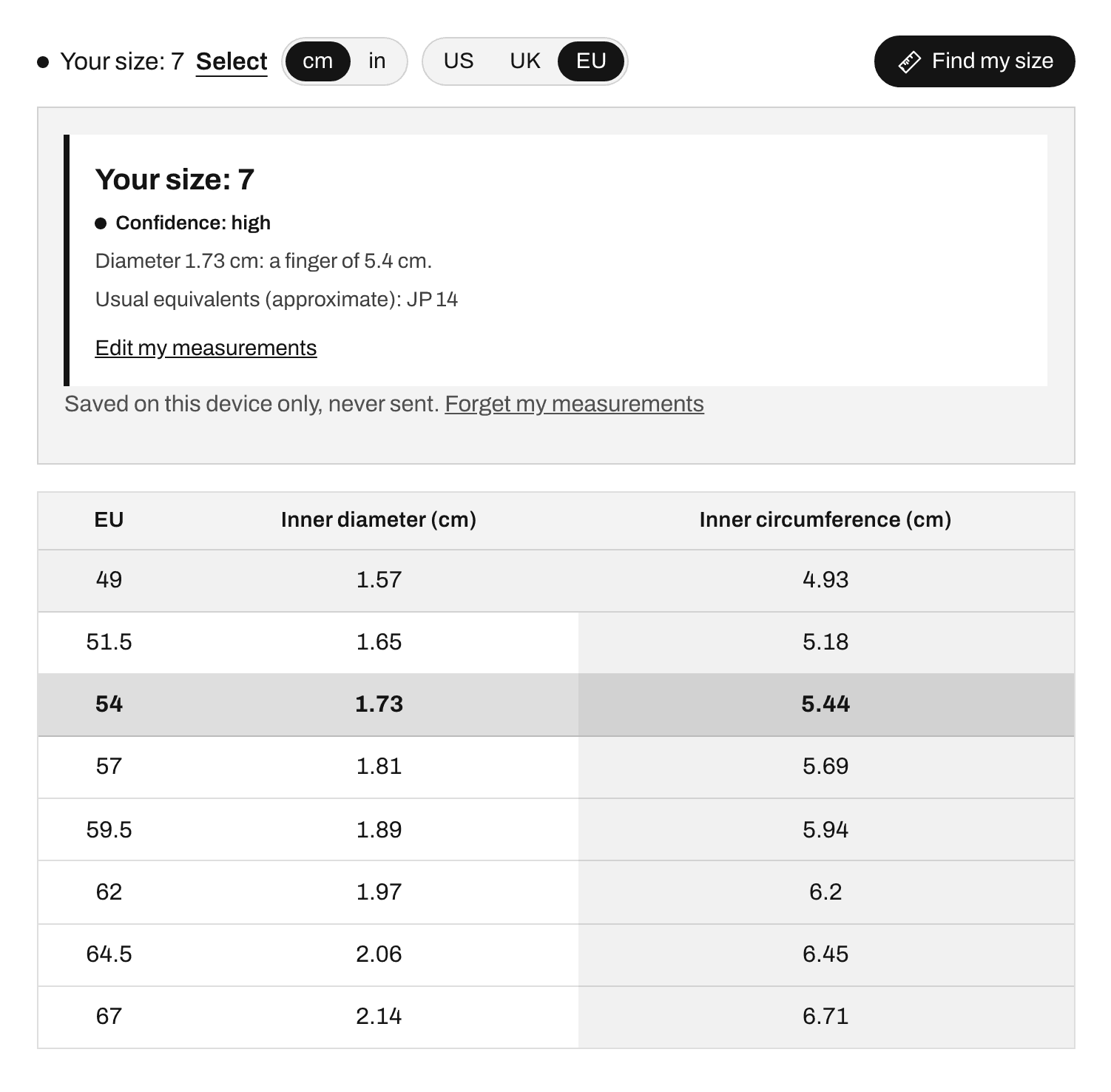
Find my size for rings asks for the finger, "Or the inner diameter of a ring that fits you", with a short help, "No tape measure? Two easy ways", for the ring and the paper methods. A diameter of 1.73 cm is said back as "Diameter 1.73 cm: a finger of 5.4 cm." and gets a 7 on the template, with the Japanese size the chart doesn't show: "Usual equivalents (approximate): JP 14". There is no "Fit I like" for rings: a ring too loose fails as surely as a ring too tight.
Questions
How can I measure my ring size without a tape measure?
Use a strip of paper and a ruler: wrap the strip around the base of the finger, mark the overlap and measure the length in millimeters. Or measure across the inside of a ring that fits, edge to edge, for the inner diameter.
Should I measure my ring size at the end of the day?
Ruban Size's Rings template says so: "Fingers swell in the heat: measure at the end of the day." Avoid measuring with cold hands, when fingers are at their smallest.
Do I need a bigger size for a wide band?
Often, yes. A wide band fits tighter, so between two sizes take the larger; Ruban Size treats bands of 6 mm and more as wide.
How do I convert a US ring size to UK or EU?
EU is the inner circumference in millimeters, and a US size is 2.55 × size + 36.5 mm around. A US 7 is about 54.4 mm around, so EU 54.5 and UK N 1/2; the table above goes from US 4 to 13.
Keep reading
- Size conversionRing size conversion chart: US, UK, EU and JapanA US 7 ring measures about 54.4 mm around the inside and 17.3 mm across. That is UK N 1/2, EU 54.5 and Japan 14. The full chart, from US 3 to 13, is below.6 min
- How to measureHow to measure your wrist for a bracelet or watch strapWrap a strip of paper just below your wrist bone, mark the overlap and measure it. Add 1.3 cm for a snug bracelet, 1.9 cm for a comfortable one and 2.5 cm for a loose one.5 min
- Find my sizeHow Find my size works, step by stepFind my size reads your chart as ranges with no gaps, works out a target for each measurement, scores every size, and shows the best one with how sure it is and why. It runs on the shopper's device and never suggests a size beyond your largest.7 min
- How to measureHow to measure your chest for clothesPass the tape under your arms and around the fullest part of your chest, keep it level all the way round, and read it after a normal breath out. That number is your chest; on a women's chart labeled bust, the tape takes the same path.6 min