
How to measure a garment flat for your size chart
Lay the garment flat and measure straight across from armpit to armpit, from the top of the shoulder to the hem, and along the sleeve. Then write "laid flat" in the header, so nobody takes half a chest for a whole one.
Garment measurements are taken on the clothes, not on a person. Lay each size flat, measure across, and publish the numbers under a header that says what they are. "Half chest, laid flat: 53 cm" describes a shirt of 106 cm around the chest. Without "laid flat", 53 cm reads like a body measurement no adult has.
This one is for merchants: how to take the measurements, how to write them in a chart, and how Ruban Size turns them into a size for a shopper who only knows their own body.
What you need
A flat table, a tape measure or a long metal ruler, and one finished piece of each size. Measure a second piece of each size if you can: the two should agree.
How to measure a garment flat
- Lay it flat, front up, buttons done up or zip closed. Smooth it with your hands without pulling: a knit stretched on the table measures larger than it is.
- Chest, pit to pit. Straight across the front, from one armpit seam to the other, just below the armholes. That's half the chest.
- Waist and hem. Straight across at the narrowest point and along the bottom edge, if they matter for the cut. Also halves.
- Body length. From the highest point of the shoulder, beside the collar, straight down to the hem. The coats and jackets template uses back length instead, from the collar seam at the back of the neck to the hem.
- Sleeve. From the shoulder seam to the end of the cuff, along the top of the sleeve.
- Shoulder width. From one shoulder seam to the other, across the back.
- Trousers and skirts. Waist across the top of the waistband, edge to edge (half). Hips across the fullest part (half). Inseam from the crotch seam to the hem. Rise from the crotch seam to the top of the waistband.
- Write it down per size, in one unit, rounded the same way for every size.
Measure the same points on every size. The difference from one size to the next is the grading, and it should go up in steady steps. A jump or a dip is worth measuring again.
Half or whole
A flat measurement across the body is half a circumference. Publish it as it is and say so, or double it and say that. The men's T-shirt template publishes it as it is:
| Size | S | M | L | XL | XXL |
|---|---|---|---|---|---|
| Half chest, laid flat (cm) | 50 | 53 | 56 | 59 | 62 |
| Length (cm) | 70 | 72 | 74 | 76 | 78 |
Doubled, the half chest gives 100, 106, 112, 118 and 124 cm around.
That template keeps these numbers in a "Garment measurements" tab, next to a "Body measurements" tab with the chest and waist of the person. The coats and jackets template does the same with back length and sleeve length, and Women's tops with length and sleeve. Shoppers who'd rather compare with a T-shirt they already own switch tabs. Sleeve points are covered in how to measure shoulder width and sleeve length.
Common mistakes
- Half without saying so. Under a plain "Chest (cm)" header, 53 reads as a body chest.
- Whole garment numbers in a body chart. A 106 cm garment chest next to "Chest" tells a shopper with a 106 cm chest to take that size, which leaves them no room at all.
- Stretching knits on the table. Smooth, don't pull.
- Different points on different sizes. One sleeve from the shoulder seam, the next from the collar.
- Flat and around in one table. Pick one, for every row.
- Rounding each size its own way. One unit, one step, for the whole chart.
What it means for a Shopify store
Garment measurements are exact (they're the clothes themselves), but shoppers don't know how much room a cut leaves over their body. A plain lookup that compares a body chest with a garment chest gets the size wrong far more often than right. In Ruban Size's benchmark of 40,000 simulated shoppers, drawn from NHANES 2015 to 2018 and ANSUR II, a plain lookup found the exact size 9 to 14% of the time on garment-measurement charts. Find my size found it 64.5% of the time. The difference is the room it adds, explained in body measurements vs garment measurements.
Two good setups: both tabs (body measurements to choose a size, garment measurements to compare with clothes the shopper owns), or garment measurements only, with a size finder that adds the room.
How Ruban Size reads garment measurements
Find my size works out whether a table holds body or garment measurements, then adjusts.
The header. Words such as "garment", "product", "flat" or "laid" mark garment measurements. Words such as "flat", "laid", "half", "½", "width" or "pit to pit" mark half measurements, which are doubled. French, German, Spanish and Italian words count too ("à plat", "largeur", "Breite"). Type "Half chest, laid flat (cm)" as a header in the editor and the row is read as a chest, in centimeters, laid flat. The tab label or caption can say "garment" for the whole table.
The values. On an adult chart, a chest under 72 cm, a waist under 52 cm or hips under 68 cm can't be a body, so they're read as laid flat and doubled. Not on kids' or dog charts, where small numbers are real.
The room. Then it adds ease for the garment type and the fit the shopper picked, taken from the pattern makers' ease allowances (Vogue, Butterick and McCall's), in centimeters around the body:
| Garment | Snug | Regular | Loose |
|---|---|---|---|
| Tops, shirts, dresses (chest) | 8.9 | 11.6 | 16.7 |
| Jackets | 10.2 | 12.9 | 20.2 |
| Coats | 15.2 | 18.9 | 25.6 |
| Pants and skirts (hips) | 6.4 | 9 | 12.9 |
For stretch fabric, a little of that room comes off. Knit tops (T-shirts, polos, sweatshirts) count as stretch unless you say otherwise.
A worked example. A woven shirt chart with "Half chest, laid flat (cm)": 50, 53, 56, 59, 62. Find my size doubles it to 100, 106, 112, 118 and 124. For a shopper with a 96 cm chest:
- Regular: 96 + 11.6 = 107.6 cm, inside M (106).
- Snug: 96 + 8.9 = 104.9 cm, also M.
- Loose: 96 + 16.7 = 112.7 cm, L (112).
The answer says what happened: "This chart gives the garment's own measurements: we added room for the fit you chose."
The settings. When a header doesn't say, the chart's Fit tab does. "Measurements in the table" takes Body measurements or Garment measurements, with the help text "Garment measurements (laid flat, product measurements) get room added for the fit; half measurements are doubled." "Room added to garment measurements" replaces the usual room for a cut that needs more or less, "Stretch fabric" turns stretch on or off, and "Try it" shows the size a shopper would get.
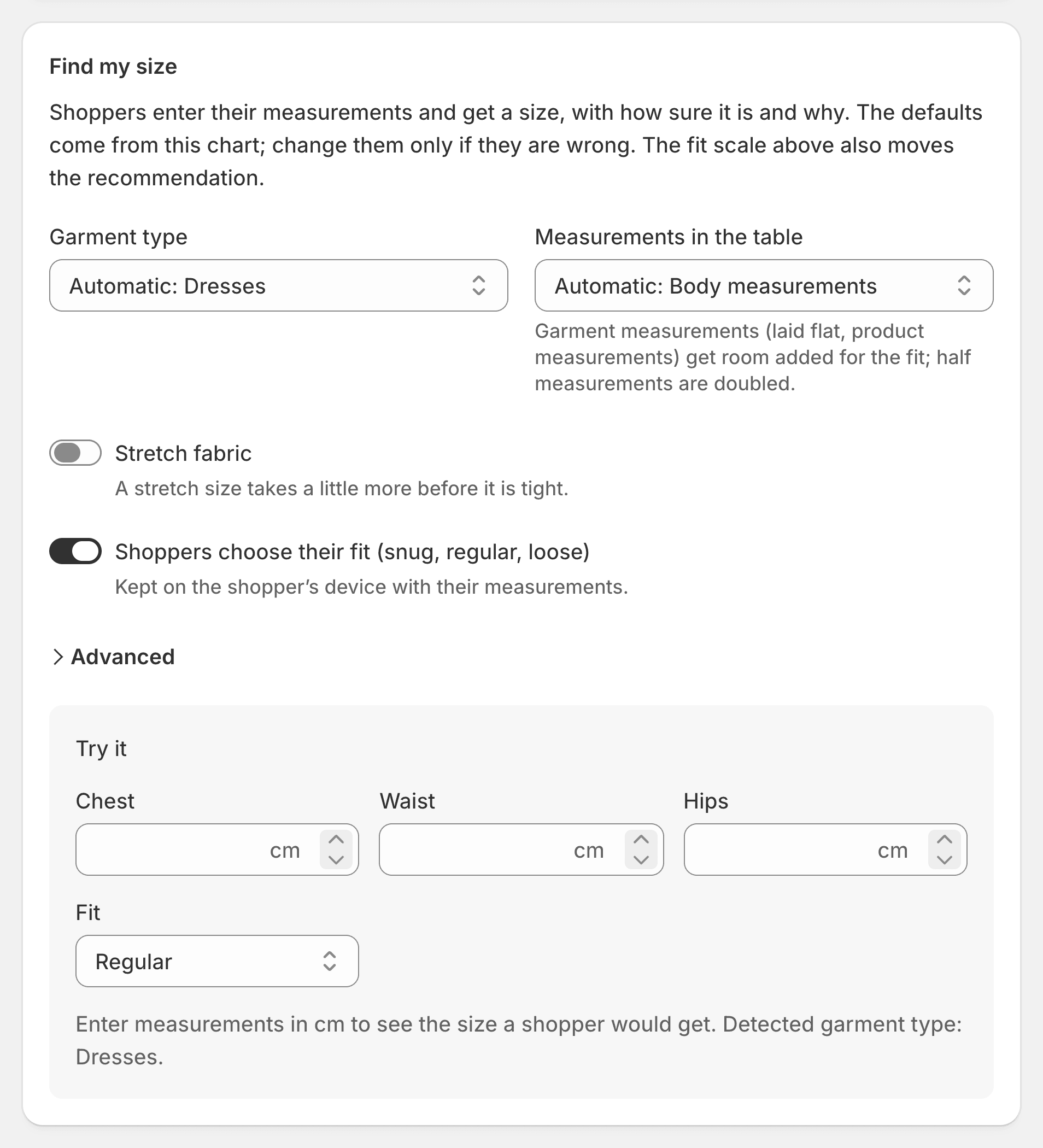
That setting prevents one mistake in particular: a garment table with plain "Chest (cm)" headers and values from 100 to 124, which are large enough to be bodies. Read as body measurements, a 96 cm shopper is told they're below the smallest size. Write "garment" in the header, the tab or the caption, or set it in the Fit tab. Everything about the grid itself is on the size charts page, and here is the men's T-shirt template with both tabs:
Questions
What does pit to pit mean?
The width of a garment laid flat, straight across from one armpit seam to the other. It's half the chest: double it for the measurement around.
How do you measure a shirt laid flat?
Button it, lay it front up and smooth it without stretching. Measure pit to pit for the chest, from the top of the shoulder beside the collar to the hem for the length, and from the shoulder seam to the cuff for the sleeve.
Should a size chart show body or garment measurements?
Body measurements are easier for shoppers to match; garment measurements describe the clothes exactly. Two tabs, one for each, serve both.
How much bigger than my chest should a shirt be?
For a regular fit, about 11.6 cm (a little over 4½ in) around the chest, from the Vogue, Butterick and McCall's ease allowances. About 8.9 cm for a fitted cut and 16.7 cm for a loose one.
Keep reading
- Sizing explainedBody measurements vs garment measurementsA body measurement is the person; a garment measurement is the product, often laid flat and halved. The gap between the two is ease, and comparing one with the other is the quickest way to a wrong size.6 min
- Sizing explainedHow much ease clothes need: the numbers by garmentEase is the garment measurement minus the body measurement. A fitted top needs about 8.9 cm (3.5 in) at the chest, a regular one 11.6 cm (4.6 in), a regular coat 18.9 cm (7.4 in). The full table by garment is below.7 min
- How to measureHow to measure shoulder width and sleeve lengthShoulder width runs across the top of your back, from the bony tip of one shoulder to the other. Sleeve length runs from that shoulder point, over a slightly bent elbow, to the wrist bone; dress shirts measure it from the center back of the neck instead, so check which one a chart means.5 min
- How to measureHow to measure your chest for clothesPass the tape under your arms and around the fullest part of your chest, keep it level all the way round, and read it after a normal breath out. That number is your chest; on a women's chart labeled bust, the tape takes the same path.6 min