
How much ease clothes need: the numbers by garment
Ease is the garment measurement minus the body measurement. A fitted top needs about 8.9 cm (3.5 in) at the chest, a regular one 11.6 cm (4.6 in), a regular coat 18.9 cm (7.4 in). The full table by garment is below.
Ease is the difference between a garment's measurement and the body inside it: garment circumference minus body circumference. A top with a 100 cm chest on a 90 cm body has 10 cm of ease. How much a garment needs depends on what it is and how it should fit: a few centimeters for a fitted top, close to 20 cm for a regular coat, less than nothing for a swimsuit.
The numbers below are the ones Ruban Size's Find my size uses when a chart gives garment measurements. Most come from published pattern allowances; a few are Ruban Size's own choices, and the table says which.
Where the numbers come from
The pattern companies Vogue, Butterick and McCall's publish "Misses' ease allowances": ranges of ease for fitted, semi-fitted and loose-fitting garments. Here are the ranges the engine quotes, in inches:
| Garment (where) | Fitted | Semi-fitted | Loose fitting |
|---|---|---|---|
| Dresses, blouses, tops (bust) | 3-4 | 4 1/8-5 | 5 1/8-8 |
| Jackets | 3 3/4-4 1/4 | 4 3/8-5 3/4 | 5 7/8-10 |
| Coats | 5 1/4-6 3/4 | 6 7/8-8 | 8 1/8-12 |
| Skirts and pants (hip) | 2-3 | 3 1/8-4 | 4 1/8-6 |
Ruban Size takes the middle of each range and calls the three fits snug, regular and loose. For a fitted top: (3 + 4) / 2 = 3.5 in, and 3.5 × 2.54 = 8.9 cm.
Four other sources fill in what the pattern table doesn't cover:
- Waists: a minimum of 1 in for dresses, and 1 to 1.5 in for skirts and pants (Threads #221, 2023).
- Shoes: inner length minus foot length of 10 to 20 mm, set against the last allowance of 13 to 25 mm in ISO/TS 19407 and the Brannock device's 2 barleycorns (16.9 mm).
- Belts: the usual rule "belt size = trouser size + 2 in", about 5 cm.
- Bracelets: the jewelers' 1/2, 3/4 and 1 in over the wrist.
The ease table, by garment
Values in cm, with inches in parentheses. "Ruban Size" in the last column marks values the engine's own notes call its choices, or derives itself, rather than reads from a published table.
| Garment | Measured at | Snug | Regular | Loose | Source |
|---|---|---|---|---|---|
| Tops, blouses, shirts | chest or bust | 8.9 (3.5) | 11.6 (4.6) | 16.7 (6.6) | Vogue, Butterick, McCall's |
| Shirt collars | neck | 1 (0.4) | 1.5 (0.6) | 2.5 (1.0) | Ruban Size |
| Dresses | bust | 8.9 (3.5) | 11.6 (4.6) | 16.7 (6.6) | Vogue, Butterick, McCall's |
| Dresses | waist | 2.5 (1.0) | 5.2 (2.0) | 10.3 (4.1) | 1 in minimum, then the bust's steps |
| Dresses | hips | 6.4 (2.5) | 9 (3.5) | 12.9 (5.1) | Vogue, Butterick, McCall's |
| Pants, skirts, shorts | hips | 6.4 (2.5) | 9 (3.5) | 12.9 (5.1) | Vogue, Butterick, McCall's |
| Pants, skirts, shorts | waist | 2.5 (1.0) | 3.2 (1.3) | 3.8 (1.5) | Threads #221 |
| Jeans | hips | 2.4 (0.9) | 6.4 (2.5) | 9 (3.5) | Ruban Size |
| Jeans | waist | 1.3 (0.5) | 2.5 (1.0) | 3.2 (1.3) | Ruban Size |
| Jackets, blazers, suits | chest | 10.2 (4.0) | 12.9 (5.1) | 20.2 (8.0) | Vogue, Butterick, McCall's |
| Coats, ski wear | chest | 15.2 (6.0) | 18.9 (7.4) | 25.6 (10.1) | Vogue, Butterick, McCall's |
| Knits: swimwear, underwear, activewear | every measure | -2 (-0.8) | 0 | 2 (0.8) | Ruban Size |
| Bras | underbust, bust | -1 (-0.4) | 0 | 1 (0.4) | Ruban Size |
| Shoes | inner length minus foot | 1 (0.4) | 1.5 (0.6) | 2 (0.8) | ISO/TS 19407, Brannock |
| Hats, gloves | head, hand | 0 | 0.5 (0.2) | 1 (0.4) | Ruban Size |
| Rings, helmets | finger, head | 0 | 0 | 0 | Ruban Size |
| Belts | belt length minus waist | 5 (2.0) | 5 (2.0) | 5 (2.0) | trouser size + 2 in |
| Bracelets, watch straps | length minus wrist | 1.3 (0.5) | 1.9 (0.75) | 2.5 (1.0) | jewelers' allowances |
| Dog coats | chest | 2.5 (1.0) | 5 (2.0) | 7.5 (3.0) | Ruban Size |
| Dog coats | neck | 1 (0.4) | 2 (0.8) | 4 (1.6) | Ruban Size |
Some values are derived rather than chosen. Jeans sit one step closer than other pants: their regular value is the pants' snug one. The dress waist starts from the 1 in minimum and adds the same steps as the bust (2.7 cm to regular, 7.8 cm to loose). Kids' clothes use the tops row, and kids' shoes get 0.3 cm more toe room.
Reading the table
Coats need the most. A coat goes over a sweater or a jacket, so it needs room for what is underneath, not only for the body.
Knits go negative. A stretch garment can be smaller than the body and still fit; that is what holds a swimsuit or a pair of leggings in place. On top of the knit row, stretch takes a share of the body measure off: 10% for swimwear, 8% for activewear, 6% for underwear. Jersey tops (T-shirts, polos, sweatshirts) keep the tops row, minus 5%.
Some products have no fit choice. A ring or a helmet either fits the finger or the head or it doesn't, so ease is zero and shoppers aren't offered snug or loose. A belt adjusts with its holes, so it is the same 5 cm whatever the fit.
A worked example
A shopper with a 100 cm (39.4 in) chest needs a garment chest of:
| Garment | Snug | Regular | Loose |
|---|---|---|---|
| Top | 108.9 cm | 111.6 cm | 116.7 cm |
| Jacket | 110.2 cm | 112.9 cm | 120.2 cm |
| Coat | 115.2 cm | 118.9 cm | 125.6 cm |
So on a jacket chart that lists garment chests, a regular fit means the size closest to 112.9 cm (44.4 in) around. If the chart gives the chest laid flat, halve it: about 56.5 cm across. How to measure a garment flat shows where to measure.
Body charts already contain ease
All of this applies to charts of garment measurements. A chart of body measurements already has the brand's ease built in: its M range is the bodies the M is made for.
On those charts, Find my size only moves the shopper's measurement by half the gap between the fit they prefer and a regular fit. For a top, that is 1.35 cm down for snug and 2.55 cm up for loose. Body vs garment measurements explains the two kinds of chart.
How Ruban Size uses these numbers
When a chart holds garment measurements (detected from headers like "laid flat" or "garment", or from values too small to be a body), Find my size adds the ease from this table for the garment type and the shopper's "Fit I like" before comparing. The answer says so: "This chart gives the garment's own measurements: we added room for the fit you chose."
Each chart's settings sit in the Fit and Find my size tab of the editor:
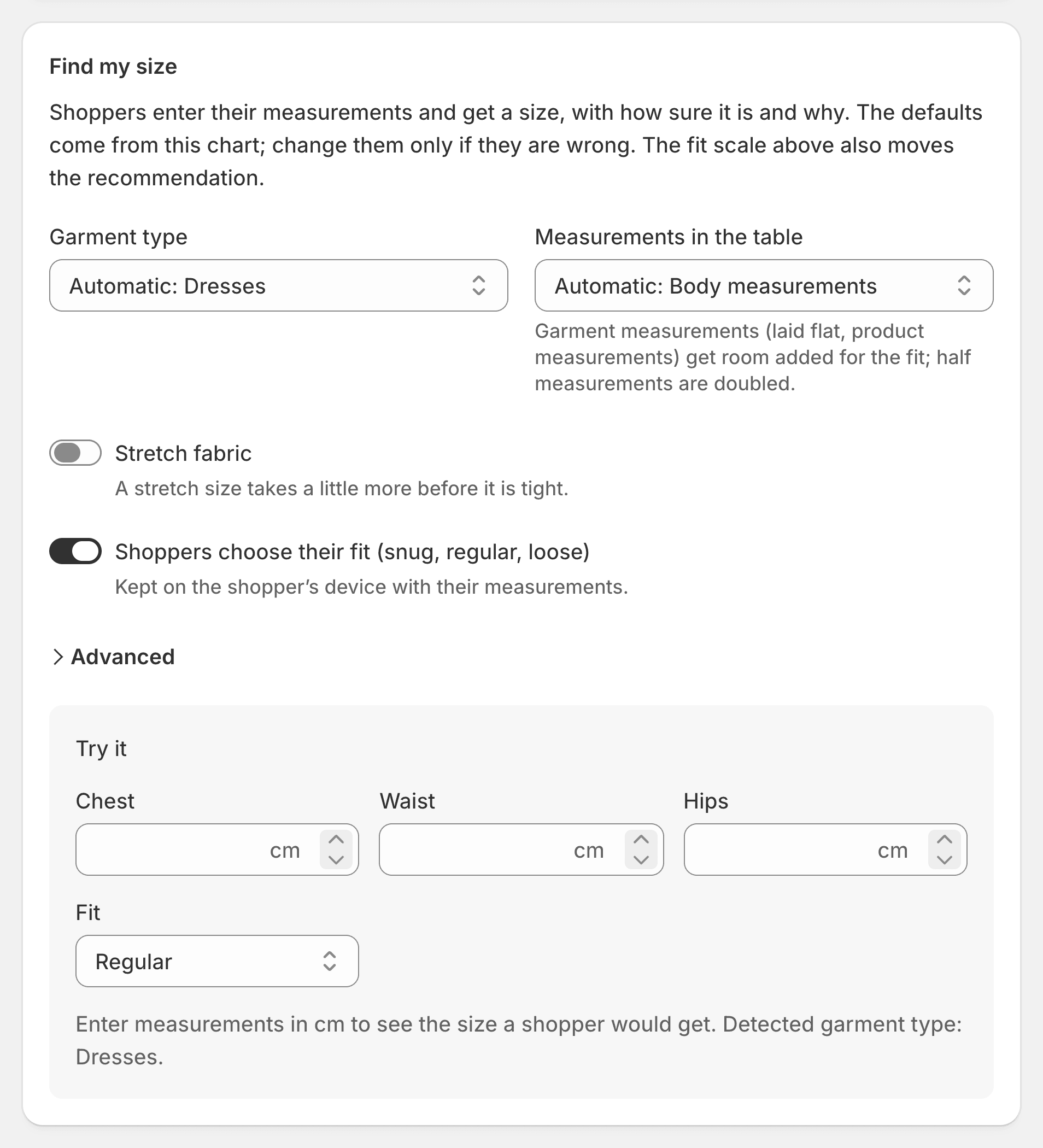
- Garment type: detected from the chart's words and measurements (20 kinds, from tops to dogs); change it if the guess is wrong.
- Measurements in the table: body or garment.
- Stretch fabric: on or off.
- Room added to garment measurements: your own regular ease in cm, if your cut differs from the usual room for its type. Snug and loose move with it.
- Try it: type measurements and see the size a shopper would get.
Belts, bracelets, rings, shoes, hats and dogs each have their own rules on top of this; fit by product type lists them. For a chart with body and garment tabs to start from, open the coats and jackets template.
Questions
What is ease in clothing?
Ease is how much bigger a garment is than the body wearing it, measured at the same place: chest, waist or hips. It is what lets you move, sit and layer.
How much ease does a T-shirt need?
On a garment chart, Ruban Size gives a jersey T-shirt the regular top ease of 11.6 cm and takes 5% of the chest off for stretch. For a 96 cm chest, that is a garment chest of about 102.8 cm, or 51.4 cm laid flat.
Do coats need more ease than jackets?
Yes. The pattern allowances give a regular coat about 18.9 cm (7.4 in) at the chest, against 12.9 cm (5.1 in) for a regular jacket, because a coat goes over other layers.
What is negative ease?
A garment smaller than the body, which only works with stretch fabric. Swimwear, leggings and underwear use it: Ruban Size's snug value for knits is 2 cm under the body measurement, before stretch.
Keep reading
- Sizing explainedBody measurements vs garment measurementsA body measurement is the person; a garment measurement is the product, often laid flat and halved. The gap between the two is ease, and comparing one with the other is the quickest way to a wrong size.6 min
- How to measureHow to measure a garment flat for your size chartLay the garment flat and measure straight across from armpit to armpit, from the top of the shoulder to the hem, and along the sleeve. Then write "laid flat" in the header, so nobody takes half a chest for a whole one.6 min
- Find my sizeHow Find my size works, step by stepFind my size reads your chart as ranges with no gaps, works out a target for each measurement, scores every size, and shows the best one with how sure it is and why. It runs on the shopper's device and never suggests a size beyond your largest.7 min
- Sizing explainedWhat "true to size" means, and how to show itTrue to size means an item fits the way its size chart says, so shoppers take the size the chart gives them. A store shows it best on a fixed scale from runs small to runs large, with one line of fit note.6 min