
How to measure biceps and thighs
For clothes, measure your biceps with the arm relaxed at your side, around the fullest part of the upper arm, and your thigh standing, around the fullest part of the leg just below the crotch, tape level. On a garment laid flat, measure straight across the sleeve or the leg at the same points and double it.
Most size charts never ask for biceps or thighs, yet that's where slim shirts, fitted blazers, jeans, cycling shorts and leggings get tight first. Both are circumferences, taken with a soft tape on a relaxed body, and both have a laid-flat twin on the garment: the sleeve width and the thigh width.
How to measure your biceps
- Wear a thin T-shirt or nothing on the arm. A shirt sleeve rolled up bunches under the tape.
- Stand straight, arm relaxed and hanging at your side, a little away from the body so the tape can pass. Don't flex.
- Find the fullest part of the upper arm, usually about halfway between the shoulder and the elbow.
- Wrap the tape around it at a right angle to the arm: with the arm hanging, the tape is level.
- Snug, not tight. The tape rests on the skin without pressing in.
- Read and write down the unit.
- Measure the other arm and keep the larger number.
Measuring your own dominant arm is awkward with the other hand. A mirror helps; a second person helps more.
How to measure your thighs
- Underwear or thin leggings. Jeans add their seams and pockets.
- Stand straight, feet about hip width apart, weight on both legs. Don't tense the leg.
- Find the fullest part of the thigh, just below the crotch.
- Wrap the tape around one thigh, level, all the way round.
- Snug, not tight, then read.
- Measure the other leg and keep the larger number.
Relaxed or flexed?
For clothes, relaxed. A size chart describes a body at rest, and the room a sleeve needs for a bent, flexed arm is the garment's job: that room is called ease, and it is built into the pattern. Flexed numbers are for tracking training at the gym. If you measure flexed for that, compare flexed with flexed.
On a garment laid flat
Merchants publish garment numbers, and shoppers can measure a shirt or a pair of jeans that fits.
- Sleeve width (biceps). Lay the sleeve flat and smooth. Measure straight across, just below the armhole, at a right angle to the sleeve's fold. That's half the sleeve around.
- Thigh. Lay the pants flat, legs together, front up. Measure straight across one leg just below the crotch seam, at a right angle to the leg. Also a half.
- Keep the point fixed. Many brands measure at a set distance below the armpit or the crotch. Whatever you pick, write it next to the chart and use it for every size.
A flat width doubles into a circumference. A sleeve 19 cm across laid flat is 38 cm around; on a 36 cm arm, that leaves 2 cm of room. The other points of a pair of pants (rise, knee, leg opening) are in how to measure pants laid flat, and shirts in how to measure a garment flat.
Common mistakes
- Flexing the arm or tensing the thigh while you measure.
- Measuring too low: near the elbow, or halfway down the thigh.
- A slanted tape. On the thigh, it creeps down at the back.
- Measuring over jeans or a rolled sleeve.
- Comparing a body with half a garment. A 19 cm sleeve laid flat isn't a 19 cm arm; double it first.
- Measuring one side only. Arms and legs aren't always the same.
What it means for a Shopify store
You don't need a biceps row on every chart. Add one where the cut makes it matter:
- Slim and athletic cuts: fitted shirts, slim blazers, tailored T-shirts.
- Close-fitting sportswear: cycling jerseys and bib shorts, compression sleeves and shorts, leggings.
- Slim and skinny jeans, where the thigh, not the waist, is often the limit.
Then say what the number is. "Thigh (cm)" alone can be a body or half a garment. "Thigh, laid flat (cm)" or "Thigh, body (cm)" can't be misread, and the same goes for biceps. A one-line fit note does the rest, written for your own cut: "Muscular thighs? Take one size up in Slim."
How Ruban Size handles biceps and thighs
Find my size works from the body measurements a chart marks as such: chest, bust, underbust, waist, hips, inseam, neck, height, weight, head, hand, hand length, finger, wrist, foot length, foot width and a pet's back length. Biceps and thigh aren't among them. A shirt is sized by its chest (and neck), jeans by waist and hips, cycling wear by chest, waist, hips and height, like the Cycling and compression wear template.
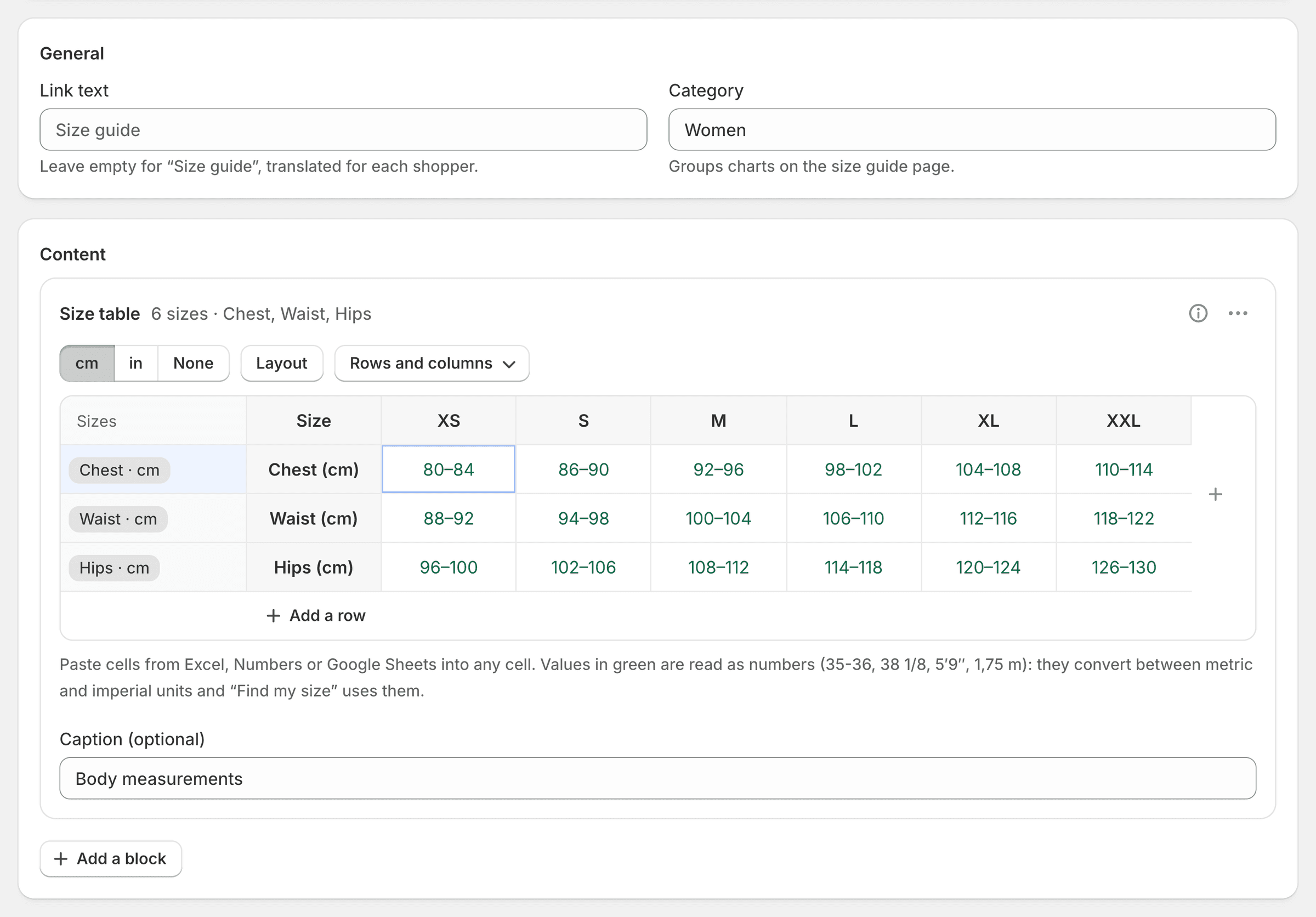
A biceps or thigh row still belongs in the table. In the editor, click the row's label and choose what it holds: "Other values", which the editor explains as "Converted when it has a unit; not used by 'Find my size'." Shoppers see it next to the other rows and switch it between cm and in with the rest of the table. Put garment rows in their own tab, as the Men's T-shirt template does with its "Garment measurements" tab.
In the How to measure block, add a step titled "Biceps:" or "Thigh:" with your own text. Biceps and thigh aren't lines a step can light up on the body figure, so set "Highlights" to "Nothing", or switch the block's drawing to "My own image, or none" and upload a sketch of the sleeve or the leg with the measuring line. Everything else about the grid (pasting from a spreadsheet, units row by row, merged cells) is on the size charts page.
The fit note carries the advice Find my size can't compute: put "Slim through the arms" or "Roomy thighs" in the chart's fit scale note, where shoppers read it before they choose.
Questions
Should I measure my biceps flexed or relaxed?
Relaxed, with the arm hanging at your side, for clothes. Size charts describe a body at rest, and the sleeve's own room covers a flexed arm.
Where do you measure your thigh?
Around the fullest part of the thigh, just below the crotch, standing with your weight on both legs and the tape level.
How do you measure sleeve width on a shirt laid flat?
Lay the sleeve flat and measure straight across, just below the armhole, at a right angle to the fold. Double it for the sleeve's circumference.
Why are jeans tight on my thighs when the waist fits?
The size is chosen by waist and hips, and the cut decides how much room the thigh gets: a slim or skinny cut leaves less. Compare your thigh with the jeans' thigh width laid flat, doubled, or take the brand's fit note into account.
Keep reading
- How to measureHow to measure pants and jeans flat: rise, thigh, leg openingButton the pants, lay them flat front up, and measure straight across the waistband, the hips, the thigh, the knee and the leg opening; then the front and back rise from the crotch seam to the top of the waistband, and the inseam down to the hem. The widths are halves, so double them for the measurements around.7 min
- How to measureHow to measure a garment flat for your size chartLay the garment flat and measure straight across from armpit to armpit, from the top of the shoulder to the hem, and along the sleeve. Then write "laid flat" in the header, so nobody takes half a chest for a whole one.6 min
- Sizing explainedBody measurements vs garment measurementsA body measurement is the person; a garment measurement is the product, often laid flat and halved. The gap between the two is ease, and comparing one with the other is the quickest way to a wrong size.6 min
- How to measureHow to measure your chest for clothesPass the tape under your arms and around the fullest part of your chest, keep it level all the way round, and read it after a normal breath out. That number is your chest; on a women's chart labeled bust, the tape takes the same path.6 min