
How to measure your neck for a dress shirt
Wrap the tape around the base of your neck, where a shirt collar sits, with one finger slipped under it, and read the number. That is the neck size a dress shirt chart asks for: on the Men's shirts template, 39 to 40 cm is an M and 41 to 42 cm an L.
Your neck size for a dress shirt is the distance around the base of your neck, where the collar sits, measured with one finger between the tape and your neck. A dress shirt is the one garment where the neck comes first: a collar that doesn't close can't be saved by a roomier chest.
How to measure your neck, step by step
- Stand straight and look ahead. Chin level, not tucked, shoulders relaxed.
- Find the base of the neck. Just below the Adam's apple at the front, where the collar of a shirt that fits rests.
- Wrap the tape around, flat, along the line a collar would take.
- Slip one finger under the tape. That is the room a buttoned collar needs. The step in Ruban Size's templates says exactly that: "around the base of your neck, one finger under the tape."
- Read it. If you land between two marks, take the larger. Note the unit.
- Measure the chest and the sleeve too. Collar first, but the shirt also has to close over your chest, and the sleeve has to reach your wrist.
Or measure a shirt that fits
Lay the collar flat and open, and measure from the center of the collar button to the far end of the buttonhole. That is the shirt's collar length, a garment measurement, and it already includes the room you like.
Common mistakes
- Measuring without the finger, then buying a collar you can't button.
- Measuring too high, around the middle of the neck rather than its base.
- Looking down or tucking the chin.
- Measuring over a collar or a scarf.
- Picking the shirt by chest alone. The fit note of the template says it the other way round: "Choose your collar size first, then check the chest."
- Comparing a collar measurement with a body chart, or the reverse. A collar laid flat is a garment measurement; your neck is a body one.
The Men's shirts template, in both units
| Size | Neck (cm) | Neck (in) | Chest (cm) | Sleeve length (cm) |
|---|---|---|---|---|
| S | 37-38 | 14.6-15 | 88-94 | 84 |
| M | 39-40 | 15.4-15.7 | 95-101 | 86 |
| L | 41-42 | 16.1-16.5 | 102-108 | 88 |
| XL | 43-44 | 16.9-17.3 | 109-116 | 89 |
| XXL | 45-46 | 17.7-18.1 | 117-124 | 90 |
Each size covers two centimeters of neck, a little under an inch. If your shirts are sold by collar size in half inches (15, 15½, 16), the same method applies: measure, then read the brand's chart. The sleeve lengths here are dress-shirt sleeves, much longer than a jacket's, and how to measure shoulder width and sleeve length explains why.
How much room a collar needs
The finger under the tape is the shopper's version of ease, the room between the body and the garment. Ruban Size's engine puts a number on it: its ease table gives the neck of a shirt 1 cm for a snug fit, 1.5 cm for a regular fit and 2.5 cm for a loose one. The other parts of a shirt need much more, as how much ease clothes need shows.
What it means for a Shopify store
Shirts sold as S, M and L hide the collar inside a letter. Shoppers who know their collar size need to see it, so list the neck in the chart, in centimeters and inches, and put the neck step first in the measuring guide. If you sell by collar size, say whether the numbers are the shopper's neck or the collar itself. In a Ruban Size size chart, every row converts between centimeters and inches with one switch.
How Ruban Size handles the neck
The Men's shirts template has neck, chest and sleeve columns, the fit note "Choose your collar size first, then check the chest.", and a How to measure block with the neck and chest steps. When a shopper points at or taps the neck step, the neck line lights up in the body figure and the neck column lights up in the table.
Find my size asks for the neck and the chest. Both count, and the one that needs the larger size wins, because a tight collar is as unwearable as a tight chest. A 41 cm neck (L, bottom of the range) with a 100 cm chest (M, top of the range) reads "You are between M and L. We suggest L.", with a line for each measurement and "M may also fit if you like a closer fit."
In the Fit tab of a chart, two settings matter for shirts:
- Main measurement, which "counts most when measurements point to different sizes". Set it to the neck and the collar leads, as the fit note says.
- Measurements in the table. If your chart lists the collar itself, choose garment measurements: Find my size then adds 1, 1.5 or 2.5 cm to the shopper's neck, for "Fit I like: Snug, Regular, Loose", before comparing. On a body chart like the template, the fit choice only nudges the comparison, a quarter of a centimeter tighter or half a centimeter looser.
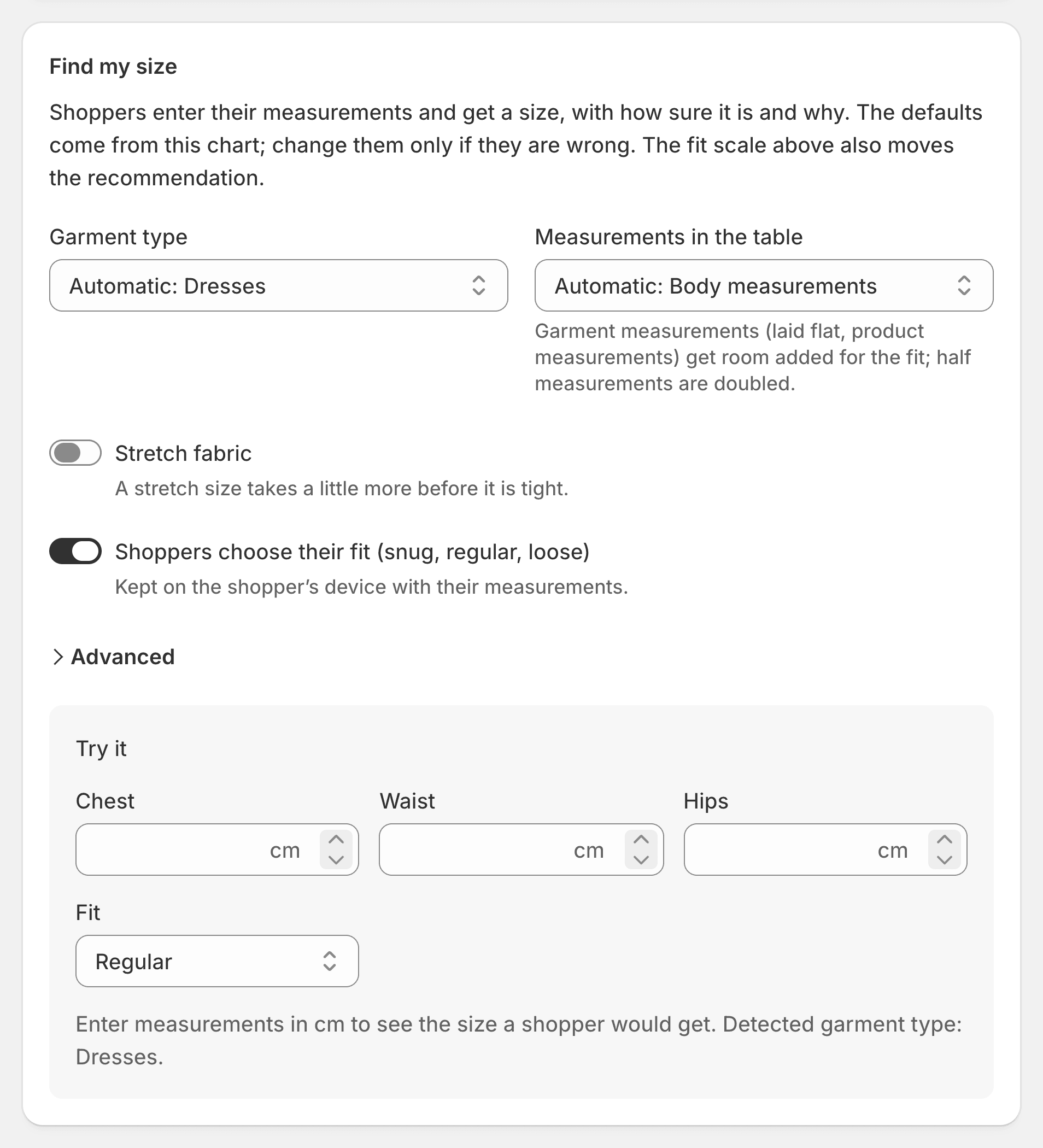
Try it with your own neck and chest:
Questions
How much room should a shirt collar have?
About one finger when you measure your neck, which is why the step says "one finger under the tape". In Ruban Size's ease table, a regular collar gets 1.5 cm over the neck, a snug one 1 cm and a loose one 2.5 cm.
Is neck size the same as collar size?
Close, but not the same thing. Your neck size is a body measurement taken with a finger of room; the collar size is the shirt's own collar, from button to buttonhole. A chart should say which one it lists.
What if my neck and chest are different sizes?
For a dress shirt, the collar comes first: take the size your neck needs, then check the chest. If the chest is then too loose, a slimmer cut in the same collar size is the usual answer.
How do I convert my neck size from centimeters to inches?
Divide by 2.54. A 39 cm neck is 15.4 in, and a 16 in collar is 40.6 cm.
Keep reading
- How to measureHow to measure your chest for clothesPass the tape under your arms and around the fullest part of your chest, keep it level all the way round, and read it after a normal breath out. That number is your chest; on a women's chart labeled bust, the tape takes the same path.6 min
- How to measureHow to measure shoulder width and sleeve lengthShoulder width runs across the top of your back, from the bony tip of one shoulder to the other. Sleeve length runs from that shoulder point, over a slightly bent elbow, to the wrist bone; dress shirts measure it from the center back of the neck instead, so check which one a chart means.5 min
- Sizing explainedHow much ease clothes need: the numbers by garmentEase is the garment measurement minus the body measurement. A fitted top needs about 8.9 cm (3.5 in) at the chest, a regular one 11.6 cm (4.6 in), a regular coat 18.9 cm (7.4 in). The full table by garment is below.7 min
- How to measureHow to measure your waist (and why pants differ)Measure your natural waist around the narrowest part of your torso, tape level, after a normal breath out. For pants and jeans, also measure where the waistband actually sits, because a pant size like 32 is a label, not always your natural waist.5 min