
Size quiz or measurements: which finds the right size?
Measurements find the right size more often, when the shopper has a tape and the chart has measurements. A quiz is faster and works without either, at the cost of an estimate. Offer measurements first, and an estimate from height and weight for shoppers who can't measure.
A size quiz asks a few questions about the shopper. A measurement finder asks for their numbers and compares them with your chart. Both end with "Your size: M". They get there in very different ways, and each is the right tool for a different moment.
Here is what each one asks, where each works, where each fails, and what we would put on a product page.
What each one asks
A size quiz usually asks height and weight, often age, and sometimes body shape, the fit the shopper likes, or the size they wear in a brand they know. It takes a few seconds and needs nothing but memory. Behind it, the tool estimates the shopper's body from the answers, or matches them against what similar shoppers bought and kept, depending on the vendor.
A measurement finder asks for the measurements your chart lists: chest and waist for a shirt, waist and hips for pants, foot length for shoes, finger for a ring. It takes a tape and a couple of minutes, and a line on how to measure each one. Then it compares body with chart, measurement by measurement.
Where a quiz works
- No tape at hand. On a phone, on the bus, at lunch. Height and weight come from memory; a hip measurement needs a tape.
- Roomy garments. On a hoodie or a parka with plenty of ease, a size either way changes the look more than the comfort, and an estimate is good enough.
- Shoppers who won't measure. Whatever the page says, some won't. A quiz still gives them a starting point instead of a guess.
Where a quiz struggles
- Bodies differ at the same height and weight. The published equations that estimate a body from height and weight carry a standard error of about 2 to 6 cm depending on the measurement, close to one clothing size. A quiz built on its own data may do better or worse; from outside, you can't check.
- Fitted products. Bras, jeans, tailored shirts, where a couple of centimeters decides the size. On a bra, EN 13402-3 moves one cup letter every 2 cm of difference between bust and underbust. A guess of the bust from weight can't hit that.
- "I wear M at another brand." That anchors your size to someone else's chart, and a medium isn't the same at every brand.
- It can't show its work. "People like you chose M" can't be laid against your chart. "Your waist is at the top of M" can.
Where measurements work
- Accuracy, when the shopper measures. It compares the shopper's real body with your real chart, so the error is the measuring error, not the gap between a body and its average.
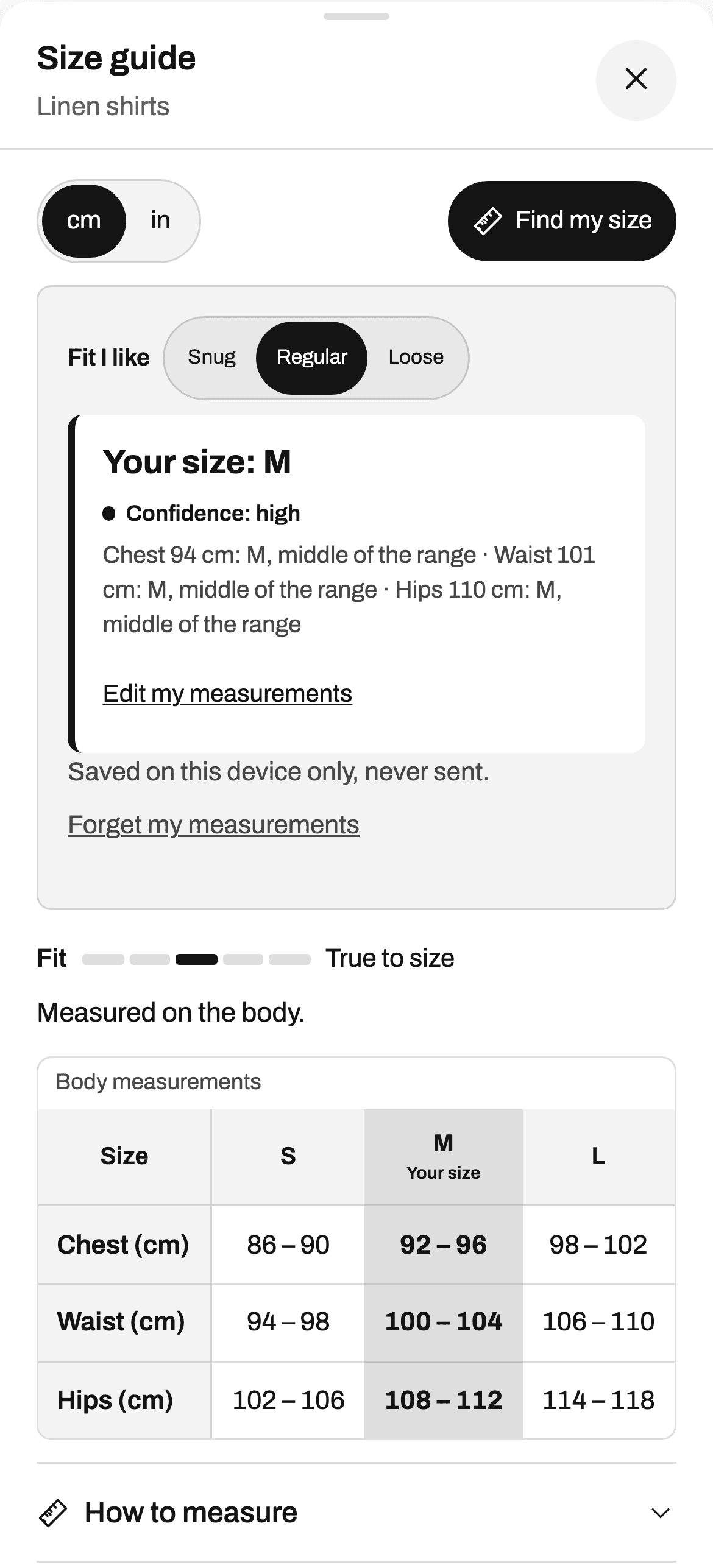
- It explains itself. One line per measurement ("Chest 94 cm: M, middle of the range") lets the shopper check the answer against the table, and trust it.
- It works on day one. A new product, a new store, a size that rarely sells: no history needed.
- No data has to leave the device. Comparing numbers with a chart can run in the shopper's browser.
We measured the gap on 40,000 simulated shoppers drawn from NHANES 2015 to 2018 and ANSUR II. With careful measurements, Ruban Size's Find my size gave the exact size to 65.8% and the size or the next to 94.5%, against 49.2% and 72.1% for a plain lookup in the same charts.
Where measurements struggle
- Measured badly, they mislead. A tape over a sweater, pulled tight, or at the wrong height. In the same benchmark, with measurements as people report them rather than measure them, the exact rate fell to 46.3% and within one size to 83.2%. The way to protect against it is a clear "how to measure" next to the fields.
- No tape, no answer. A shopper without a tape gets nothing, unless there is a fallback.
- Charts without measurements. A chart that only says S, M and L gives the finder nothing to compare with. The chart has to list chest, waist or foot length.
Side by side
| Size quiz | Measurements | |
|---|---|---|
| What the shopper needs | Memory | A tape and a couple of minutes |
| Best on | Roomy garments, shoppers without a tape | Fitted garments, bras, jeans, shoes, rings |
| Error comes from | Bodies differ at the same height and weight | How well the shopper measures |
| Explains its answer | Depends on the vendor | Measurement by measurement |
| New products | Depends on the data it has | Works at once |
| Needs a chart with measurements | Depends on the vendor | Yes |
What to offer
Measurements first, with a short "how to measure" right beside the fields, because they give the answer a shopper can check. Then an estimate from height and weight for the shoppers who don't have a tape, shown honestly: as an estimate, with the chances of each size, and with an invitation to measure.
What not to offer is an estimate dressed as a certainty. A single size with a green tick, from a body the tool has never measured, teaches shoppers to order two.
How Ruban Size does it
Find my size asks for the measurements your chart has, in the shopper's units, with how to measure each one. It answers with one size, a confidence, one line per measurement, and the neighbor size when it is a real alternative. It is on every plan, the free one too, and 37 of the 39 templates have it ready, from tops to bras, shoes and rings.
On the Fit plan, a link under the fields, "Don't know your measurements? Use your height and weight", swaps them for sex, height, weight, age and an optional body shape. The answer is an estimated size with its chances, like "M 55% · S 24% · L 19%", and the line "This is an estimate, not a measurement. For the best fit, measure yourself and enter your measurements." The sources and the limits of that estimate are in can you guess a size from height and weight?.
Ruban Size doesn't run a quiz trained on past orders. Both paths run in the shopper's browser, and what they type stays on their device. The plans are on the pricing page, and how the measurement path reaches its answer is in how Find my size works.
Questions
Are size quizzes accurate?
They can be close, but they estimate the body from a few answers, and bodies of the same height and weight differ by about a clothing size. Look for a quiz that shows its answer as an estimate with odds.
What if a shopper doesn't have a tape measure?
Offer an estimate from height and weight, clearly labeled as one. For rings, a strip of paper around the finger or a ring they already own works too; Find my size explains both.
Which is better for bras?
Measurements. A bra size comes from the underbust and the bust, and EN 13402-3 moves one cup letter every 2 cm, closer than any estimate from height and weight can get.
Can I offer both on Shopify?
Yes. Ruban Size's Find my size works from measurements on every plan, and the Fit plan adds the height, weight and age estimate in the same window.
Keep reading
- Find my sizeWhat a size recommender is, and the three kindsA size recommender turns what a shopper knows about their body into one size of your chart. It works from their measurements, from an estimate based on height, weight and age, or from a quiz or a model trained on past orders. Each kind trades the shopper's effort against certainty.5 min
- Find my sizeCan you guess a size from height and weight?Roughly, yes. Equations from large body surveys estimate chest, hips and waist from height, weight and age, but two people of the same build can differ by about a clothing size. Show the result as an estimate with the chances of each size, and invite the shopper to measure.6 min
- Find my sizeHow Find my size works, step by stepFind my size reads your chart as ranges with no gaps, works out a target for each measurement, scores every size, and shows the best one with how sure it is and why. It runs on the shopper's device and never suggests a size beyond your largest.7 min