
What a size recommender is, and the three kinds
A size recommender turns what a shopper knows about their body into one size of your chart. It works from their measurements, from an estimate based on height, weight and age, or from a quiz or a model trained on past orders. Each kind trades the shopper's effort against certainty.
A size chart lists numbers. A shopper has a body. A size recommender does the matching between the two and answers with one size: "Your size: M". It sits in the size guide or next to the size selector, and the good ones say why.
What separates recommenders is what they ask the shopper for, and what they do with it. There are three kinds.
Kind 1: from the shopper's measurements
How it works. The shopper measures the parts your chart lists (chest and waist for a shirt, waist and hips for pants, foot length for shoes, finger for a ring) and types them in. The recommender compares each number with the ranges of each size and applies sizing rules: go by your largest measurement that matters, what to do between two sizes, how much room a garment needs.
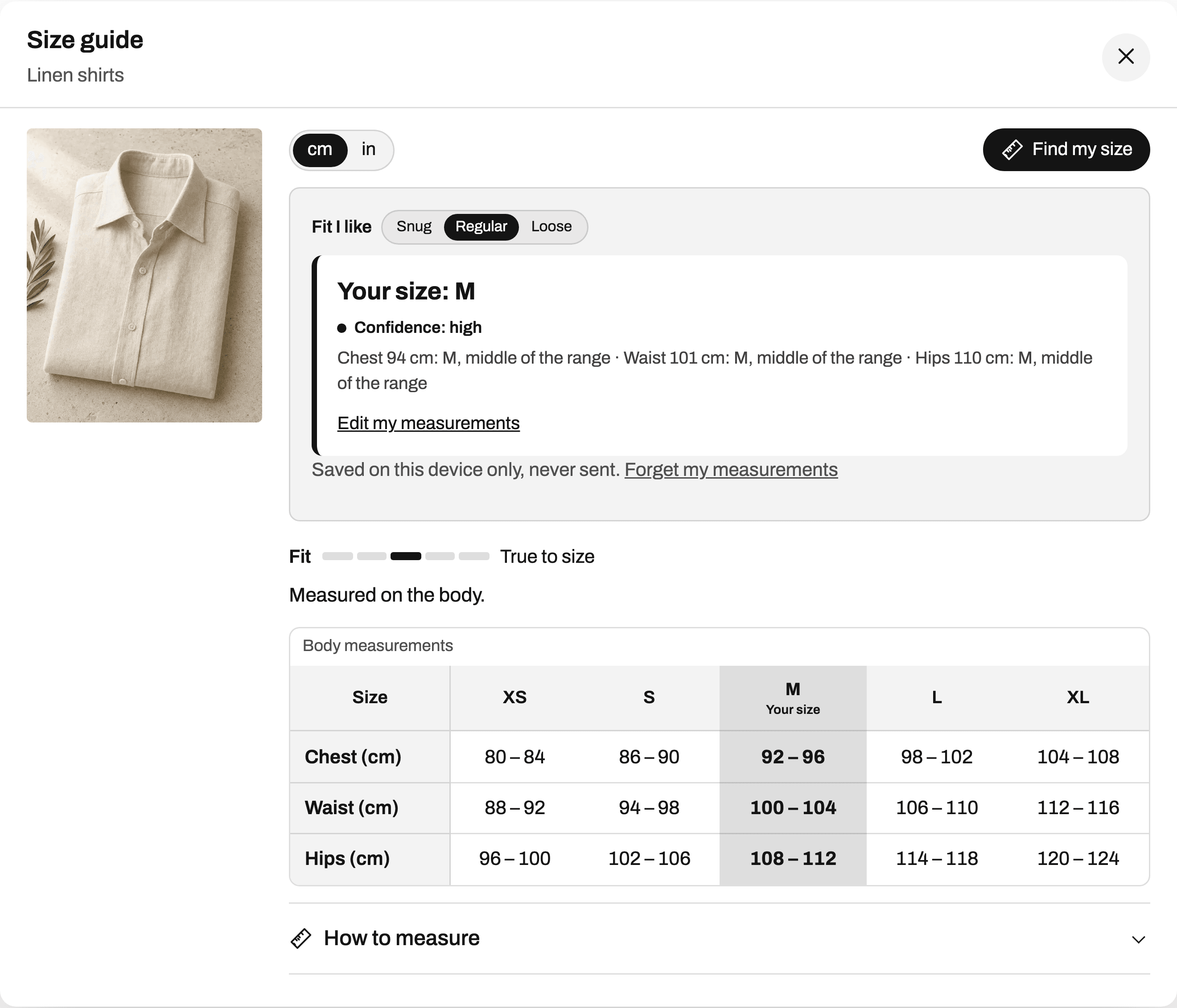
What it does well. It compares like with like, the shopper's body against your chart, so it can explain itself measurement by measurement ("Chest 94 cm: M, middle of the range"). It works on a product launched this morning, because it needs no sales history. And it can run entirely on the shopper's device, so their measurements never have to leave it.
Where it falls short. The shopper needs a tape measure and a minute. Measurements taken over clothes or with a tight tape give a wrong answer from a right chart. And it is only as good as the chart: a chart with sizes and no measurements gives it nothing to compare.
Kind 2: from height, weight and age
How it works. The shopper gives height, weight, age and sex. Equations fitted on large body surveys estimate their chest, waist and hips, and the recommender compares those estimates with the chart like kind 1.
What it does well. No tape. Most shoppers know their height and weight, so it answers in a few seconds, on a phone, anywhere.
Where it falls short. Two people of the same height and weight can have quite different chests and waists. The published equations carry a standard error of about 2 to 6 cm depending on the measurement, close to one clothing size, so an honest estimate is "M, probably" rather than "M". The equations also only hold for adults within the range of the surveys. We go through the sources and their limits in can you guess a size from height and weight?.
Kind 3: quizzes and models trained on past orders
How it works. A quiz asks a few questions: usually height and weight, sometimes age, body shape, the fit the shopper likes, or the size they wear in a brand they know. Some tools then match the answers against what similar shoppers bought and kept or returned, using a model trained on order and return history. How each tool does it depends on the vendor.
What it does well. No tape, and it can feel effortless. A model with enough history on a product can pick up how that product really fits, including quirks no chart shows.
Where it falls short. It needs history: a new product, a new store, or a size that rarely sells has little to learn from. To compare a shopper with past orders, the answers and the order history have to meet somewhere, which usually means the vendor's servers. And the answer is hard to check: "people like you kept M" can't be laid against your chart the way "your waist is at the top of M" can.
Side by side
| From measurements | From height and weight | Quiz or past orders | |
|---|---|---|---|
| What the shopper gives | Their measurements | Height, weight, age, sex | Answers to a few questions |
| Needs a tape measure | Yes | No | No |
| Works on a brand new product | Yes | Yes | Depends on the data it has |
| Says why | Measurement by measurement | As an estimate, with the odds | Depends on the vendor |
| Needs order history | No | No | Usually |
| Main weakness | The shopper has to measure | Bodies differ at the same height and weight | Needs data, hard to check |
Which kind to offer
Measurements first. When the shopper measures, a recommender that compares body with chart is the one you can check and explain, and it works from day one. Then an estimate from height and weight for the shoppers who don't have a tape, shown as an estimate, with its odds, and with an invitation to measure.
Whatever you pick, two things matter more than the kind. A good recommender says how sure it is, and it refuses to push a size that doesn't exist: if the shopper is above your largest size, the honest answer is "above our largest size", not XXL.
How Ruban Size does it
Ruban Size's Find my size is kind 1, on every plan. Shoppers type the measurements your chart has and get one size, a confidence (high, medium or low), one line per measurement, the neighbor size when it is a real alternative, and a sentence when they are between two sizes. "Fit I like: Snug, Regular, Loose" changes the answer at once. It recognizes 20 product categories, with their own rules for rings, shoes, bras, belts, hats and dogs, described on fit by product.
On the Fit plan it adds kind 2. A link, "Don't know your measurements? Use your height and weight", swaps the fields for height, weight, age and sex, and the answer comes with the chances of each size, like "M 55% · S 24% · L 19%". It uses only published equations (ANSUR 1988, Cheverud et al. 1990, and Bozeman et al. 2012 for the waist), never for under 18s, and always says it is an estimate.
Ruban Size doesn't do kind 3. The recommendation runs in the shopper's browser and their measurements are saved on their device only, so there is no shopper data on our side to train anything on. We tested Find my size on 40,000 simulated shoppers drawn from NHANES 2015 to 2018 and ANSUR II: 65.8% got their exact size and 94.5% their size or the next, against 49.2% and 72.1% for a plain lookup in the same charts. How it reaches its answer is in how Find my size works, and the plans are on the pricing page.
Questions
What is a size recommender?
A tool on a product page that suggests one size of the store's chart from what a shopper knows about their body: their measurements, their height and weight, or answers to a few questions.
Are size recommenders accurate?
It depends on what they get. From careful measurements against a chart with measurements, a recommender can be right most of the time; from height and weight, the answer is an estimate that can miss by a size.
Do size recommenders need shopper data?
A recommender that works from measurements can run entirely on the shopper's device. Ones trained on past orders need order and return history, usually on the vendor's servers.
Is a size quiz the same as a size recommender?
A quiz is one kind of size recommender, the one that asks questions instead of measurements. We compare the two in size quiz or measurements.
Keep reading
- Find my sizeHow Find my size works, step by stepFind my size reads your chart as ranges with no gaps, works out a target for each measurement, scores every size, and shows the best one with how sure it is and why. It runs on the shopper's device and never suggests a size beyond your largest.7 min
- Find my sizeCan you guess a size from height and weight?Roughly, yes. Equations from large body surveys estimate chest, hips and waist from height, weight and age, but two people of the same build can differ by about a clothing size. Show the result as an estimate with the chances of each size, and invite the shopper to measure.6 min
- Find my sizeSize quiz or measurements: which finds the right size?Measurements find the right size more often, when the shopper has a tape and the chart has measurements. A quiz is faster and works without either, at the cost of an estimate. Offer measurements first, and an estimate from height and weight for shoppers who can't measure.5 min