
Return reasons that tell you what to fix
A return reason helps when it says which way the size missed (too small or too big) and, better still, where (the waist, the sleeves, the band). "Doesn't fit" points nowhere, and "changed my mind" isn't about the chart. Ask for a reason on every return, then read them by size.
Shopify keeps a reason on each returned item. Most stores read those reasons as a total: so many returns this month, so many about size. A reason is worth more than that, because a good one names the fix. "Too small" on a size M points at one row of one chart. "Changed my mind" points at nothing in the chart, and a plain "size" says something went wrong without saying which way.
This is how to sort the reasons you get, what each kind tells you, and how to get more of the useful kind.
Four kinds of return reason
| Kind | Examples | What it tells you | Where to look |
|---|---|---|---|
| Direction | Too small, too big, too loose | Which way the size missed | That size's numbers, the chart's fit scale |
| Direction and place | Waist too small, sleeves too long, band too tight | Which way, and on which measurement | That measurement's row, and how to measure it |
| No direction | Size, fit, wrong size | Something about size, not which way | Nothing yet: ask, or keep it apart |
| Not about size | Changed my mind, damaged, wrong item, color | Not the chart | Photos, description, packing, picking |
Only the first two kinds can tell you to move a size up or down. The third is a size problem you can't act on yet. The fourth belongs on someone else's list: the photographer, the warehouse, whoever writes the product description.
"Not as described" needs a second look. The thing that wasn't as described can be the color in the photos, the fabric, or the size chart itself. Read the returns of that product together before you file them away.
Why the direction matters
Two returns of M, one too small and one too big, cancel out. Two returns of M, both too small, are the start of a pattern. The count is the same; the meaning isn't.
Here is one pair of jeans, with 60 days of returns sorted by kind, and the rule Ruban Size uses: a size is flagged from 3 size returns (too small plus too big) when at least 70% of them point the same way.
| Size | Too small | Too big | No direction | Not about size | Verdict |
|---|---|---|---|---|---|
| 28 | 0 | 1 | 2 | 1 | Not enough yet (1 size return) |
| 30 | 3 | 0 | 1 | 0 | Runs small (3 of 3) |
| 32 | 2 | 2 | 0 | 2 | Mixed |
| 34 | 1 | 4 | 0 | 0 | Runs large (4 of 5) |
Size 28 has four returns and says almost nothing: only one of them has a direction. Size 30 also has four, and three say the same thing. Size 32 comes back both ways, which points less at the cut than at how shoppers choose it: a range that is too wide, or a measuring step people read two ways. Size 34 leans clearly large.
The returns with no direction stay out of the verdict. They are not wasted, though. A size with many of them is a size where you should ask customers what happened.
What to fix, reason by reason
- Too small (or too big) in one size. Check that size's numbers first: a range copied from the next size, a typo, a centimeter value in an inch row. Then check the product: a new batch can be cut differently.
- Too small across most sizes of a chart. The cut runs small. Set the chart's fit scale to runs slightly small and add a note that says what to do: "if you are between two sizes, take the larger one." How to write it is in fit notes that help.
- The same place, again and again. "Waist too small" on jeans whose hips fit points at the waist row, or at the way shoppers measure it. If your jeans sit below the natural waist, say on the chart where to put the tape.
- Mixed, both ways. Shoppers on both sides of the same size. Tighten the measuring steps with one line per measurement, and give shoppers a size from their own numbers instead of leaving them to read the table.
- No direction. Ask before you record the return. "Too small or too big?" is one question, and it turns a return you can't use into one you can.
Getting reasons you can use
The reason is decided at the moment the return is created, by you in the admin or by the customer when they ask for a return. A few habits make it a better one:
- Ask for a reason every time you create a return in Shopify, including the ones you create by hand.
- Give your products a product category. Shopify only offers the size reasons (too small, too big) for products that have one.
- Map your returns app's reasons to Shopify's, if you use one, so the reason lands on the return itself.
- Record exchanges as returns, with the reason of the size that came back. A new size sent without a return leaves no trace of which size missed. The exchange side is in writing a size exchange policy shoppers trust.
- Keep the reasons honest. A size return filed as "changed my mind" to save a question, or a damaged item filed as "too small", makes both counts wrong.
How Ruban Size reads them
On the Fit plan, returns by size (Insights, then Returns by size) reads the orders of the last 60 days and their return reasons, in your browser, while the page is open. Nothing is stored, nothing is sent to Ruban Size's server, and no customer name, email or address is read: only items, sizes and reasons.
Each returned item lands in one of the kinds above. The finer reasons count in their direction: a waist too small or a band too tight counts as too small, sleeves too long as too big. "Size" or "fit" alone is counted as having no direction and stays out of the verdicts. Returns recorded without any reason are counted apart, and if fewer than half of your returns have one, the page warns you that the verdicts rest on too little.
Then the rule from the table above: a size is flagged from 3 size returns when at least 70% point the same way, and a whole chart from 5. Next to a chart that leans one way, one click sets its fit scale to runs slightly small or slightly large, with a note, and Find my size moves its answer with the scale. A fit note you wrote yourself is kept. The full walk-through is in reading your returns by size.
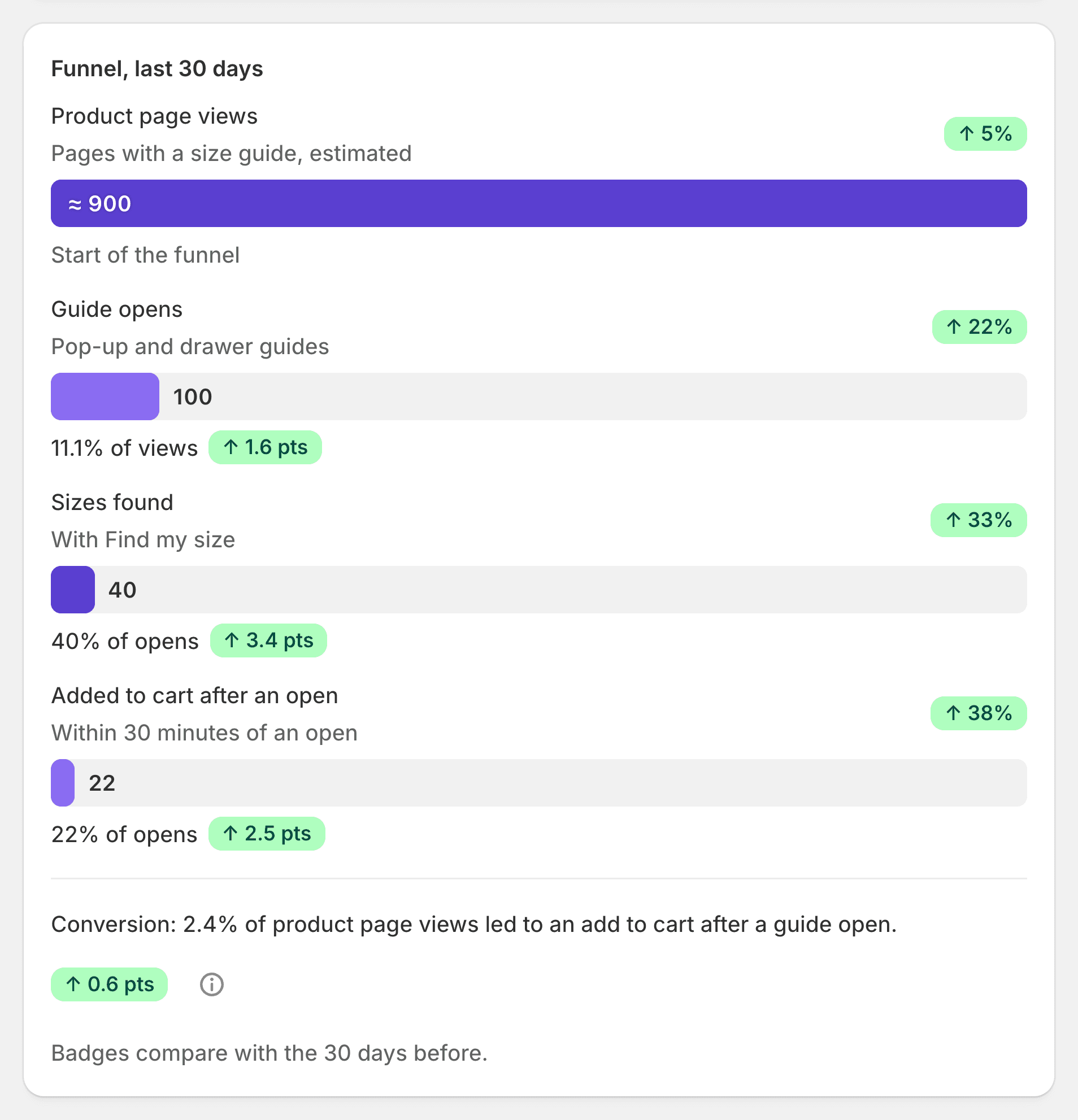
The Statistics tab adds one more number: the size return rate of orders where a size guide was opened, next to the rate of the others. Read it as a sign, not as a controlled test: shoppers who open a guide are not the same shoppers as those who don't.
Returns by size and the detailed statistics are on Fit, at $9.99 a month or $99 a year, with a 14-day free trial. The plans are on the pricing page, and the statistics on analytics and returns.
Questions
What are return reasons in Shopify?
The reason recorded on each returned item when a return is created, by the merchant in the admin or by the customer when they request the return. Size reasons like too small and too big are offered for products that have a product category.
Which return reasons help fix sizing?
The ones with a direction: too small or too big, and better still, where it missed (waist, sleeves, band). Reasons without a direction, like "size" or "fit", say something went wrong but not which way to move.
What should I do with "doesn't fit" returns?
Ask the customer one question before you record the return: too small or too big? If you can't, keep those returns apart from the ones with a direction rather than guessing which way they went.
How many returns before I change a size chart?
Ruban Size flags a size from 3 size returns when at least 70% point the same way, and suggests a new fit scale for a whole chart from 5. Fewer than that can be two shoppers who measured over a sweater.
Keep reading
- ReturnsReading your returns by sizeCount each size's returns as too small against too big. When one size keeps coming back the same way, the chart or the cut is off for that size, so fix the numbers or the fit scale. Ruban Size does the counting from Shopify's return reasons.6 min
- ReturnsFit notes that help: "runs small" and the fit scaleA fit note helps when it names the cut and says what to do: "Slim cut: if you are between sizes, take the next size up." Put it under a fixed five-step fit scale, and let the size finder move its answer with the scale.6 min
- ReturnsHow to reduce size returns in a Shopify storeA size return is a shopper who guessed. Put a readable chart next to the size option, in their units, with how to measure and a fit note, give them a size from their own measurements, then read which sizes still come back.6 min
- ReturnsWhy shoppers order two sizes, and how to stop itShoppers order two sizes when they can't trust any single one. Give them one size with its reasons, keep it for them on every product, and show a neighbor size only when it is a real alternative.5 min